


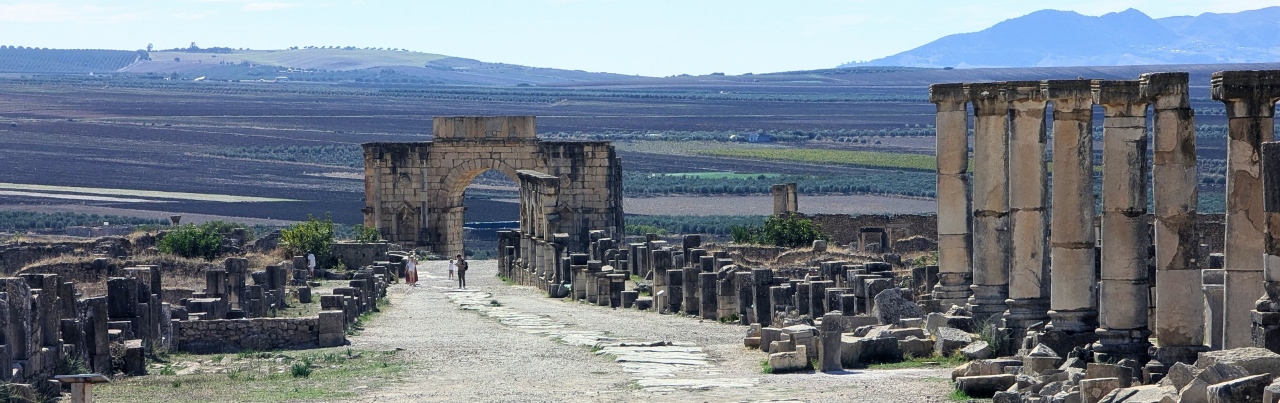
I felt a tingle of excitement to be back in Morocco. It’s only a few hours from Spain by ferry, but it’s a world away. This was my second trip to this colorful, friendly culture. I had 10 days in Morocco for a road trip from Chefchaouen to Marrackech.
Morocco is the perfect blend of Arabian, European, and Berber cultures, bringing together strands of ancient civilizations and contemporary influences. Everywhere there is evidence of mingling. Take food, for example. Once you’ve had your fill of Berber tagine, Andalusian-influenced pastilla and paella will tickle your taste buds. Arabic culture overlays traditional Berber society, but mystical Gnawa music signals influences from sub-Saharan Africa. There’s a lot to sort out.
A few years ago, my husband and I had carved out time to dip down to Morocco after a road trip meandering around Portugal and western Spain by car (see Two Week Road Trip Through Portugal and Spain). On that trip, we traveled through Morocco mostly by train. Dropping down the coast from Tangier to Fez, we rolled into Marrakech. From there we explored village life on a three-day tour to the Sahara Desert and ventured up to the Atlas Mountains in Imlil. This time, I wanted more. Picking up where we left off, I realized the inland route I wanted to take wasn’t served by trains.
We thought about renting a car, but after a week driving down the Mediterranean Coast, we were ready to leave the driving to someone else.
See Road Trip Along Spain’s Mediterranean Coast from Barcelona to Marbella.
To find a driver, I drew upon our previous tour to the Sahara Desert. Impressed with the driver we had hired through Berber Camp Merzouga, I inquired about a custom itinerary. They responded right away with an offer. They created an itinerary from Tangier to Marrakech with lodging, air-conditioned vehicle, and English-speaking driver. To be clear, we did not request a guide, just a driver.
See Berber Camp in the Sahara.
The plan worked beautifully. Since we only requested a driver, I planned on either exploring on our own or finding a guide locally if needed. However, I learned from our driver that Berber Camp Merzouga had arranged for a local guide in each location as part of their service. The guides, who spoke excellent English, were a bonus. Their half-day tours gave us a foundation from which to explore on our own. Each guide gave us ideas for things to do and made restaurant recommendations.
This Morocco trip followed a larger journey down the coast of Spain, ending in Tarifa. From Tarifa, we caught a ferry to Tangier. The time on the ferry gave me time to daydream about what we had seen in Spain and prepare to transition from Europe to Morocco.
See Traveling from Southern Spain to Morocco by Ferry.
Being so close to Spain and Portugal, and with the history of French colonial rule in the early 1900s, it’s not surprising that the accents on the ferry were a mélange of Arabic, French, Spanish, Portuguese, and English.
We had seen some sights when we had visited before, and this time I wanted to learn more about the foods of Morocco. Mohammed, our guide for a food walking tour in Tangier (Best Tangier Private Tours), packed the route with all the best examples of familiar favorites and unexpected treats.
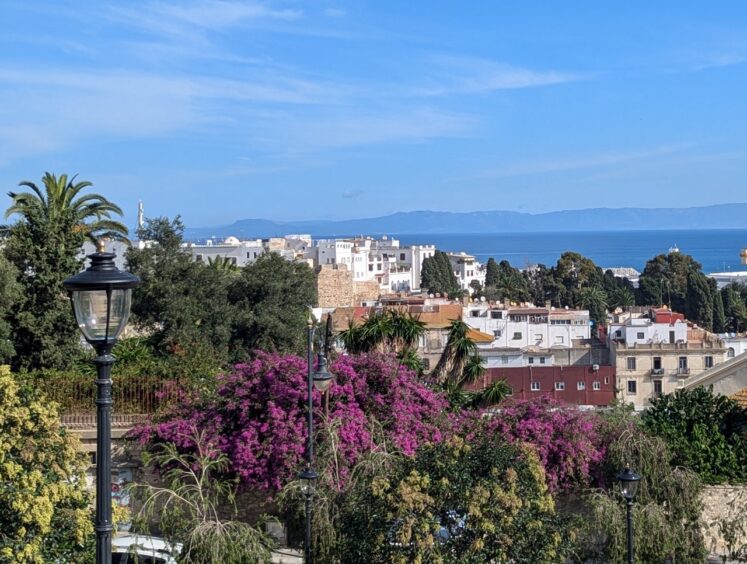
Desperate to walk off our food-tour stupor, we walked through the medina on a bright, sunny afternoon. We stood at the highest spot, looking over the Strait of Gibraltar. The sky was so clear that I felt like I could reach across the blue water to touch Spain on the other side.
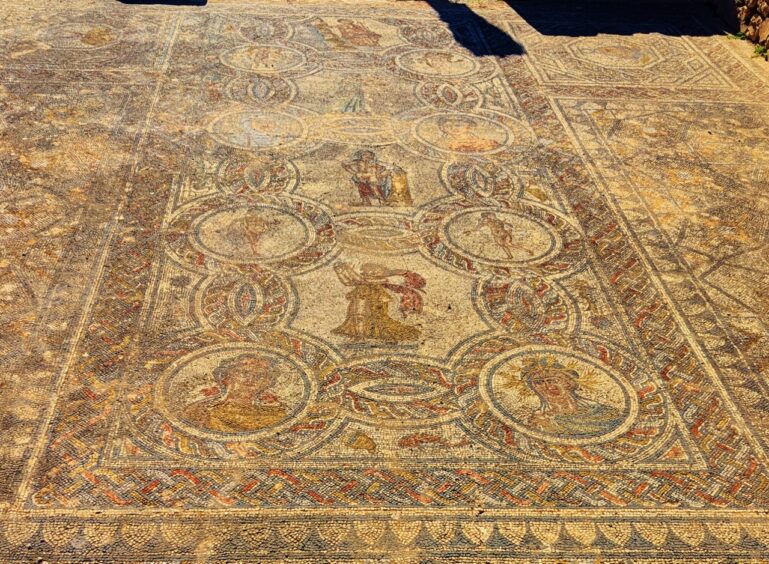
Spotting the Kasbah Museum, we dropped in to learn about Phoenician trade routes and got a preview of mosaics we’d see later at Volubilis. As interesting as the displays were, I was just as fascinated by the many rough brick columns and arches throughout the building, which was a former sultan’s palace.
Our driver picked us up on time the morning of our departure and drove two and a half hours southeast to Chefchaouen.
For this trip, we wanted to stay in riads, the traditional Moroccan homes, within medinas (historic old town) in each city.
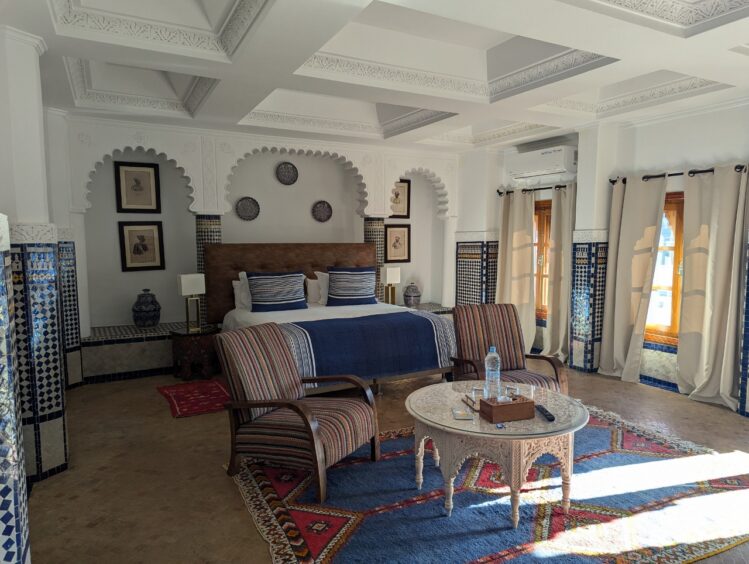
In Tangier, we booked Riad Tanja by Chef Moha. Luxurious finishes graced the enormous room with traditional fabrics and designs, complete with a sitting area. Narrow staircases wound around to the upper floors, setting the pattern for the rest of the trip. A certain degree of fitness was essential, though the hotel staff was unfailingly helpful in moving our luggage. We savored exquisite meals served in the upstairs dining room, and they even had a wine list (not always the case in this Muslim country).
See Introduction to Tangier, Morocco via Spain.
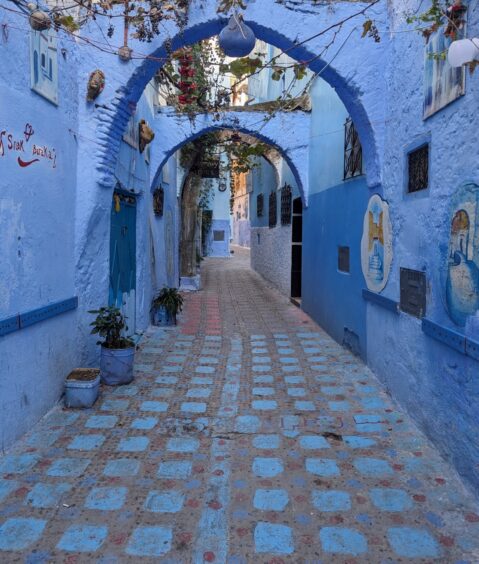
Our first impression of Chefchaouen was that it lived up to its reputation as the Blue City. The many buildings painted blue stood out in the historic old town where we stayed. The origins of the blue tradition are now hazy and widely debated but are striking.
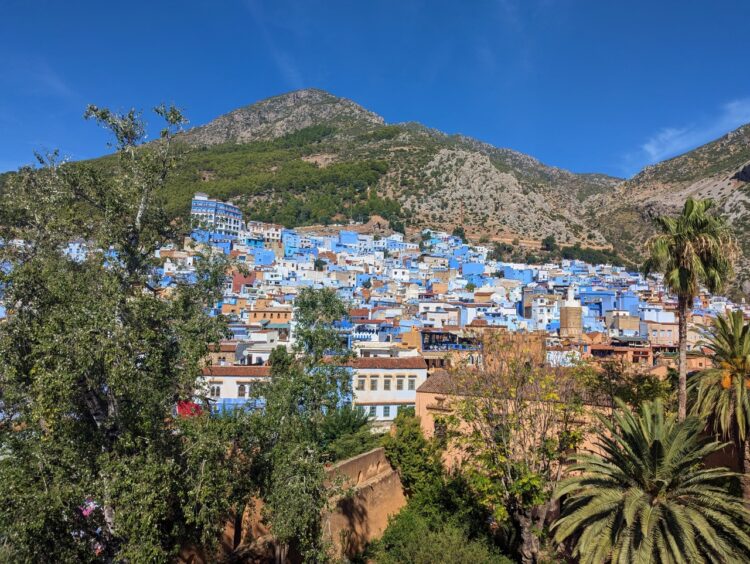
It could hardly help but be picturesque. All the shades of blue contrast with white walls and red tile roofs marching up a steep hill in the rugged Rif Mountains.
In the main plaza of Chefchaouen, Plaza Uta el-Hammam, was a prominent red-walled kasbah, a 15th-century fortress that formerly served as the governor’s residence. We wandered through the small garden, cringed at the thankfully unused dank prison, and noted the octagonal minaret of the Great Mosque.
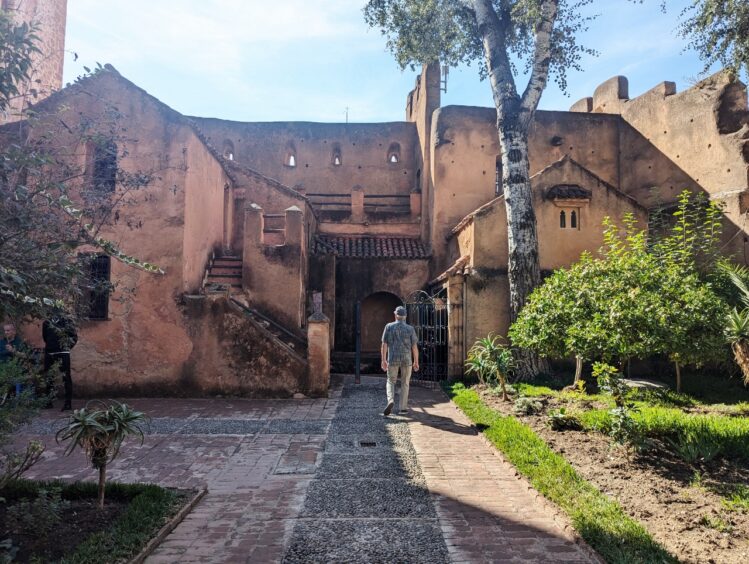
We especially noted the loudspeaker pointed across the plaza at the hotel where we were staying. The next morning, I flew out of bed with the 5 AM call to prayer, convinced that the speaker was inside our room. I enjoy the other four call-to-prayer times during the day, but the early morning one got me every time.
Our unexpected guide was so helpful in sorting out the complex mix of Berber, Jewish, and Spanish influences evident in its cuisine (paella!), architecture (terracotta-tiled roofs), and language, which blends bits of Spanish with Arabic and Berber (Amazigh) languages.
I loved the laid-back vibe and the ease of walking through the medina, though some of the narrow lanes were steep. Life’s necessities were on sale along with a good number of tourist-oriented handicrafts.
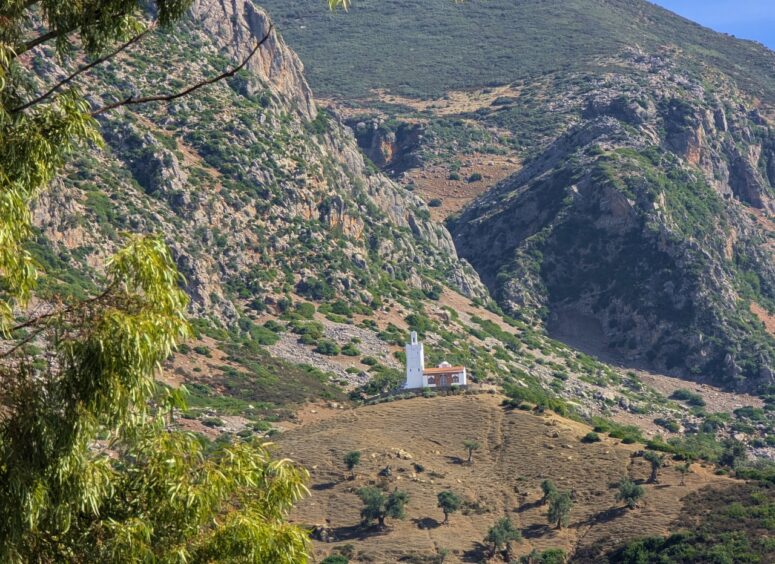
Every evening, masses of people streamed to the west-facing Spanish Mosque to watch the sunset, unifying people from all walks of life. Standing on a ridge overlooking the city, the deepening hues spreading across the medina created a special moment to remember.
It’s an easy one-mile walk to the site from the medina.
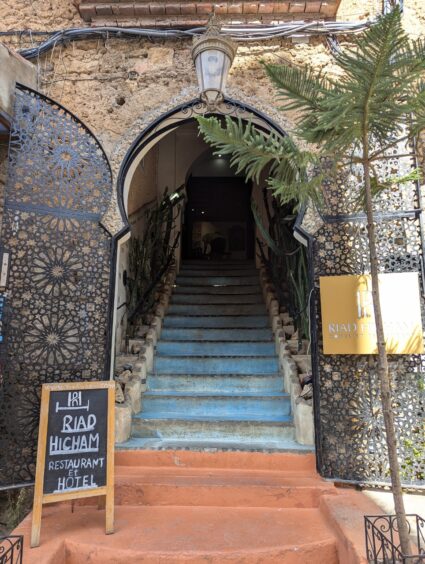
We stayed first at Chez Hicham Hotel. While it was located at the bottom of the hill, it didn’t prevent a cardio workout. I lost track of the number of flights up the maze of stairs, maybe four or five, to the Royal Suite, passing kitchens and restaurants on the way. The suite featured two large rooms and a private bath, with well-worn but comfortable furnishings. The restaurant served meals throughout the day.
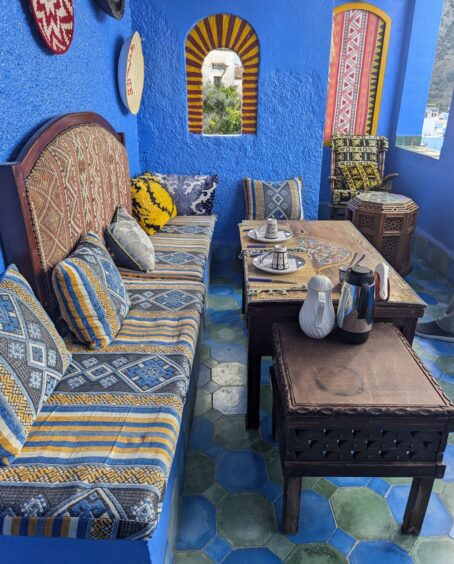
On our last night, we moved to Riad Dar Laman 2 because Chez Hicham didn’t have space. Being much further up the hill, we got to experience a smaller, family-run riad filled with warmth, intimacy, and vibrant colors.
Our guide had recommended Triana Restaurant, mentioning that they had a wine list. We enjoyed a glass of red wine with our pasta Bolognese and spicy wok shrimp from the eclectic menu. Alcohol is not served during Ramadan.
When we left Chefchaouen, the manager of our riad offered me a bottle of water. I declined because I already had water.
“You’re going on a long journey through the desert. Never turn down water,” he said.
I took the water. We were never far from civilization on the three-hour drive from Chefchaouen to Volubilis, but these few words cracked open insights into an age-old world when journeys carried constant danger.
Hugging the edge of the mountain ranges that eventually lead to the vast Sahara Desert, I thought about the old times before modern transportation made travel so easy. Instead of camel caravans, we now have cars, buses, and planes. Old traditions linger, and gifts of water still carry deep meaning.
Through the car window, I saw men whacking trees with long sticks. Branches shuddered and as the trees came into focus, I recognized the silvery-gray olive trees. They were harvesting olives by knocking the fruit down the way they always had. No machines. Just man against tree.
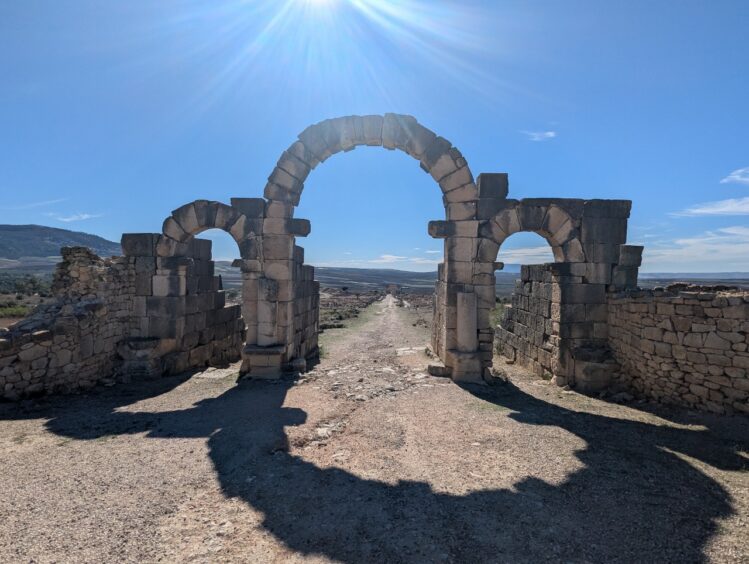
Our destination was the site of Roman ruins at Volubilis. How did the Romans end up here? I eagerly approached the archeologic site, curious about the intersection of Romans, Berbers, and Arabs in the area. It turns out that first the Romans took advantage of Berber hospitality in the 1st century CE, then the Arabs came along in the 8th century CE to establish the first independent Islamic state in this fertile valley.
Most tourists stayed clumped together near the mostly intact forum and basilica at one end of the remains of the city. We wandered through the outline of the residential neighborhoods marked by intact columns along a wide central road whose walls had crumbled to just a foot or two. Smaller lanes separated blocks of housing radiating out from the central plaza.
The solitude was delicious. Long rays of afternoon light lulled me into a vision of the thriving Roman city surrounded by golden fields of wheat and silvery olives. I could picture women gathering food at the market to prepare for dinner, children playing in the streets, and men laboring in the fields.
Allow two hours to fully experience the site, longer if you have a special interest in tile work. There is no shade. Late afternoon is a pleasant time to visit when the sun is past its peak. Bring water or purchase drinks in the parking lot.
It was another 45 minutes to Meknes, our destination for the next two nights.
Meknes was a surprise. It’s only an hour from Fez, a prime tourist destination we had visited on a previous trip. From Fez, stops in Meknes and Volubilis make a good day trip.
We had two nights in Meknes, and at first it didn’t seem like there was much of a tourist focus. That was the appeal as well, but it took some time to get into the laid-back rhythm of the city.
The reality of a medina that didn’t cater to tourists was that the rows and rows of decorative spoons and photos of veiled women were replaced by items local residents actually need. We walked through acres of athletic shoes, jeans, socks, and T-shirts. It also meant that the usual restaurants and cafes that catered to tourists were absent. After visiting medinas in several cities, I decided that I like ones that have a mix of goods meant for both tourists and locals.
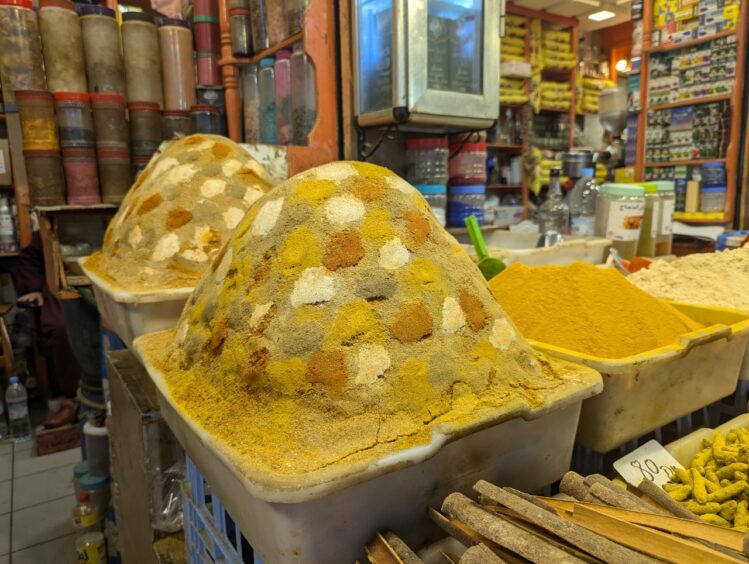
At dusk, we set out from our riad to find a place for dinner, realizing that most of what we had seen were coffeeshops filled with men and Moroccan fast food sold out of stalls. Street food can be great for a snack, but we were tired and hungry. We needed a quick, yet hearty meal. We ended up returning to our riad to ask for directions to a restaurant located outside the medina.
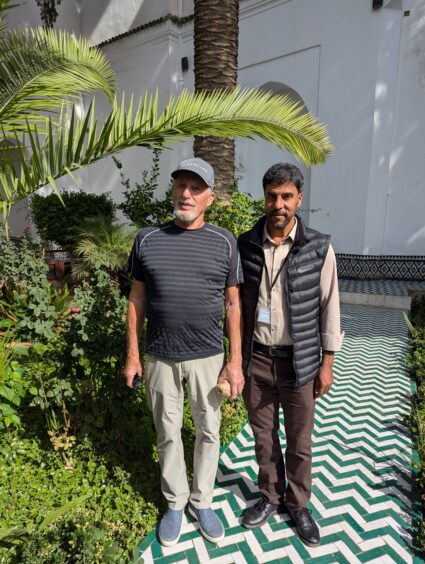
This is one place where the guide made all the difference. In other cities in Morocco, including Tangier, Fez, Marrakech, and Chefchaouen, we didn’t need a plan. We could wander around and find plenty of attractions and eateries. But here, the sights hid in plain sight, just needing some pointers about where to find the good stuff.
Our guide opened a world of wonder, first taking us on a very special visit inside a mosque. Despite having grown up in predominantly Muslim cultures, I had never been inside a mosque. I read that the only mosque open to tourists was in Casablanca, but they allowed us in this one, at least in the outer chambers. This mosque also functions as the Mausoleum of Moulay Ismail, a 17th-century sultan who ruled a unified Morocco from Meknes, elevating it to one of the four imperial cities.
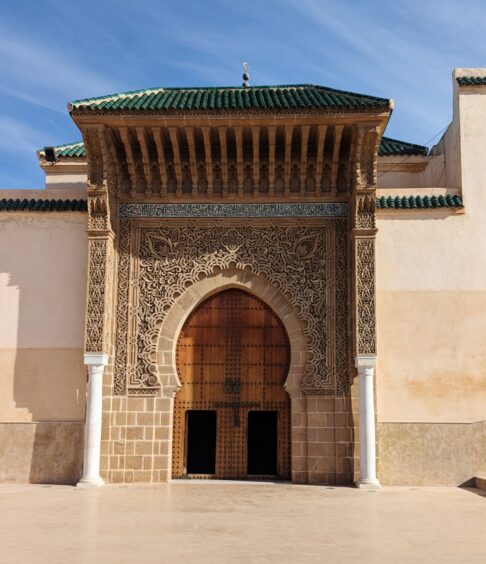
I dressed relatively conservatively, in long, loose pants and a white long-sleeved linen top, and our guide assured me there was no requirement to cover my head. After removing my shoes, I loved feeling the outline of the cool tiles against my toes. The patterns and vibrant colors of the tiles made me think of what we had just seen in Volubilis. I realized how faded the pigments were in the ruins with the perpetual exposure to the sun. The soaring ceilings, soft light, and marble columns gave the interior a peaceful, serene feeling as we stood in the anteroom to the tomb, since non-Muslims can’t access the tomb itself.
Our guide pointed out that the reason we couldn’t find the enormous Bab El Mansour Gate to the old city was that scaffolding needed for repairs obscured the view. No tile work for us. Luckily, we had seen a lot already.
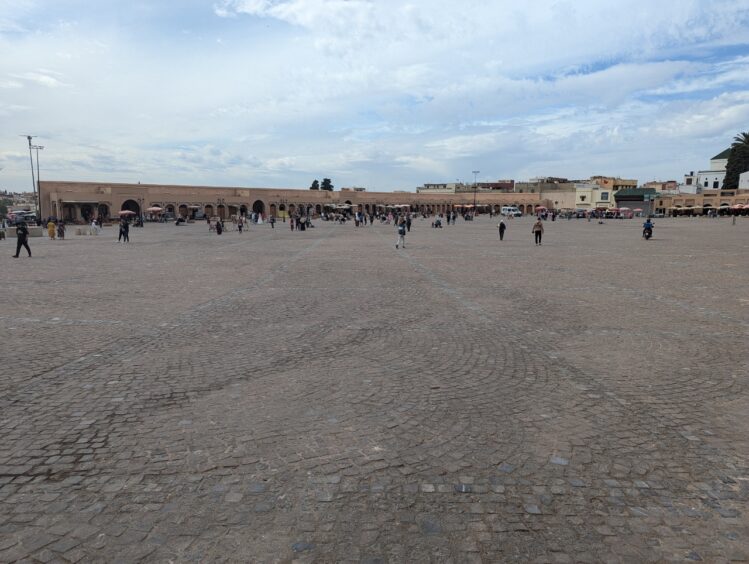
We couldn’t miss the vast Al Hadeem Square, where everyone in the city met up for coffee or shopping. He acknowledged the lack of restaurants inside the medina and provided tips for that night’s dinner. He showed us the vibrant produce market on the far side of the square, which we had missed, so we enjoyed the incredible feats of balance of hundreds of olives, dates or nuts stacked in fantastic geometric shapes.
Cutting through the jeans and T-shirt stalls, he directed us to an antique store. Despite our disinterest in buying rugs, eventually we realized we had to have a rug. You can’t fight it. If you go to Morocco, odds are you’ll come home with a rug. We’re two for two on our visits to Morocco, and we love our rugs.
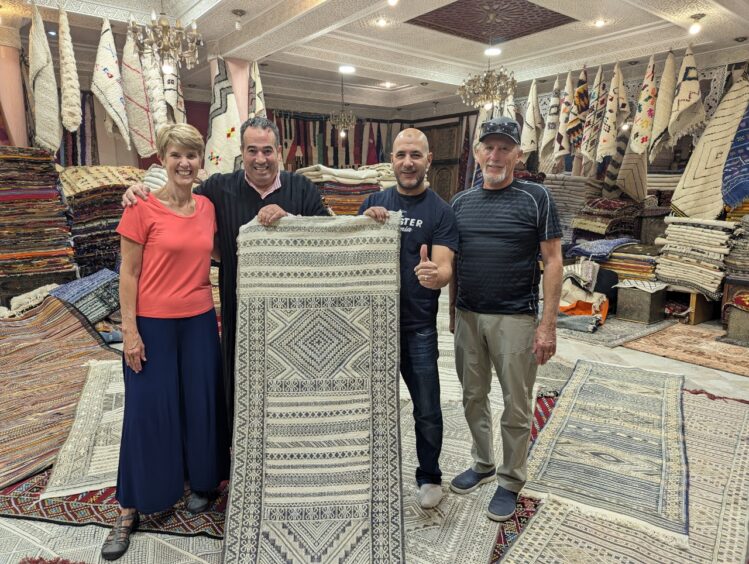
Rug commission in hand (I assume), it was time for our guide to say goodbye. Before he left, he directed us to the Dar Jamai Museum in a nondescript building on the square. After lunch, we ventured over there and spent an enjoyable few hours looking at the displays, but also at the gorgeous tile in every room. I had to spend a few moments just taking in the hues and designs first, before I could focus on the artifacts.
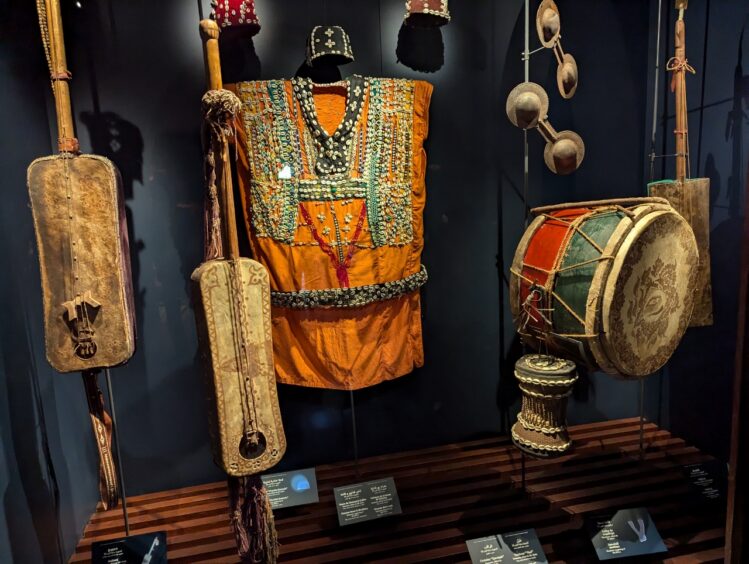
The focus was on music and dance, with displays of musical instruments I had never seen before. Videos showed how people played the instruments along with traditional tribal dancers. We saw trumpets and flutes made of horns and watched dances that incorporated sub-Saharan African traditions.
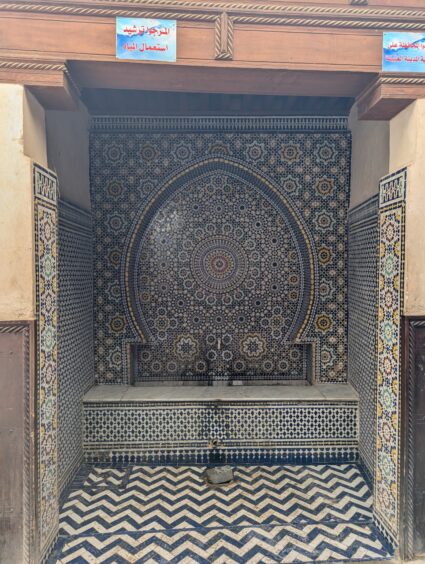
The Riad D’Or, located inside the medina, featured room after room of hand cut zellige tile. A large airy dining room with soaring ceilings was enchanting, and enticing secret passages drew us to explore the convoluted layout on countless levels. Outdoors, we never felt unsafe but wished the lightbulbs in the very dark lane functioned at night.
On our first night, a woman at our riad pointed us to restuarant down a confusing tangle of streets leading out of the medina and into a neighborhood crowded with traffic. After a 15-minute walk, we found the tiny restaurant storefront of Dar Nia Restaurant. We ascended three flights of stairs to reach the seating area. The meal was lovingly prepared, and had I not been famished and exhausted, I would have appreciated the delightful setting and delicious flavors of the lamb tagine even more.
The second night, on the suggestion of our guide, we walked five minutes to the Palais Salma Pavilion Restaurant. That evening, we enjoyed chicken tagine and kebabs under the stars on the expansive rooftop.
After a five-hour drive, where we looped over to the Atlantic coast briefly before angling east again, our guide dropped us off in Marrakech.
We had been in and out of Marrakech several times previously but missed most of our planned sightseeing because of illness. This time, we were healthy and ready to tackle the big city. I planned one event for each day and left the rest of the time for wandering.
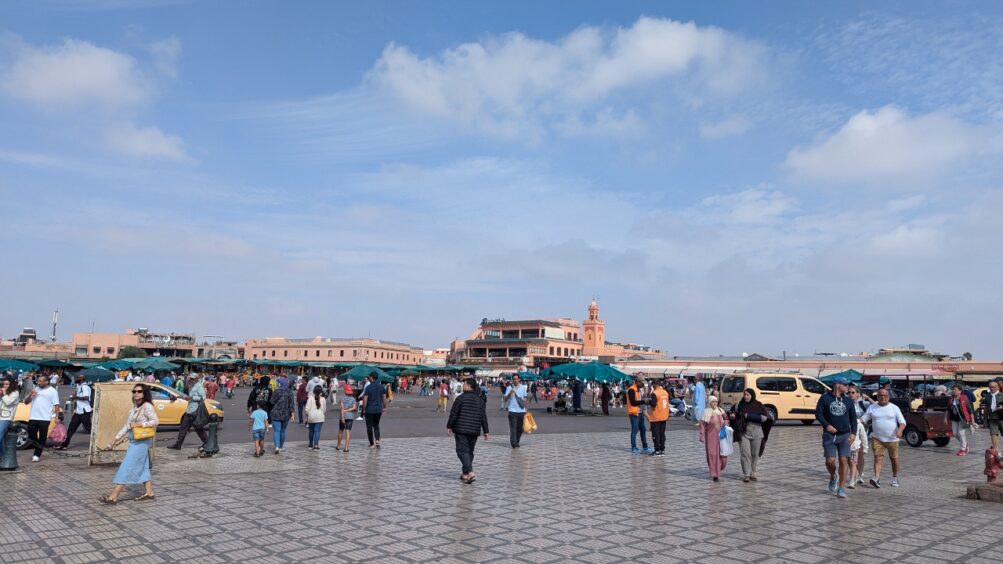
From our hotel, it was a 20-minute walk to the Jamal El Fna plaza that anchors the edge of the medina. It never seemed that long because there was so much to observe along the way.
First, we’d check the shoes left outside the small neighborhood mosque near our hotel, then we’d peek into the dim room of the community oven to see if any tourists were in there. We’d admire the stacks of khobz bread on the flatbed cart at the corner of Rue de la Kasbah. On this busy street, we’d scope out a different café to have dinner every night. At the next corner, we’d walk by the big Kasbah Mosque, built in 1190. I always looked up to admire the minaret with its graceful arches and fleur-de-lis motif. From there, it was a relatively straight shot down to the plaza.
There’s always something going on there, with food stalls, street musicians, and general pandemonium.
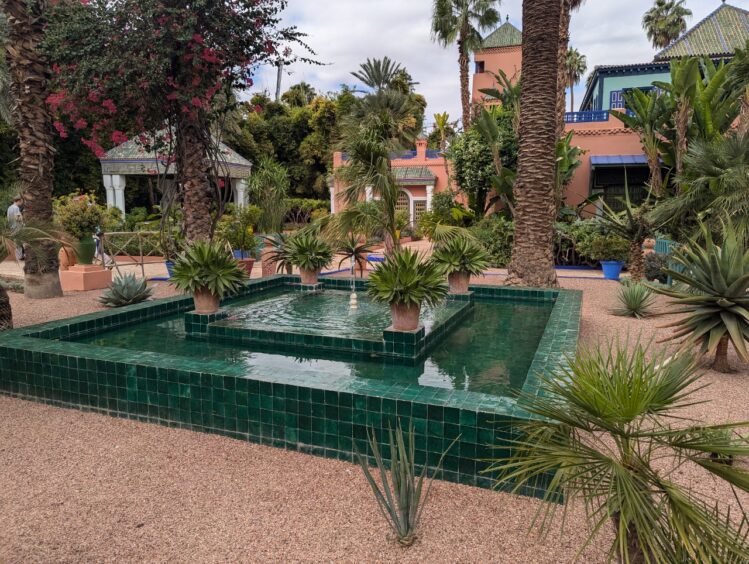
One of my favorite activities was Yves Saint Laurent’s Jardin Majorelle. It was fascinating to see the tranquil garden and think about how the Moroccan culture and environment might have informed his art and given him respite from the pressure he was under. The peaceful gardens featured exotic plants, water features, and a surprisingly modest home where he could escape.
This popular venue requires some planning to acquire advance tickets, which are timed. We took a taxi there so we wouldn’t miss our timed entry and walked home, which took nearly an hour. We got a lot of exercise that day.
White Flowers cooking class (Cookly.me) was another highlight. We went to the market with our guide and cooking instructor and made two different kinds of delicious tagine.
See Savoring Morocco: A Journey Through Spices and Stories for more.
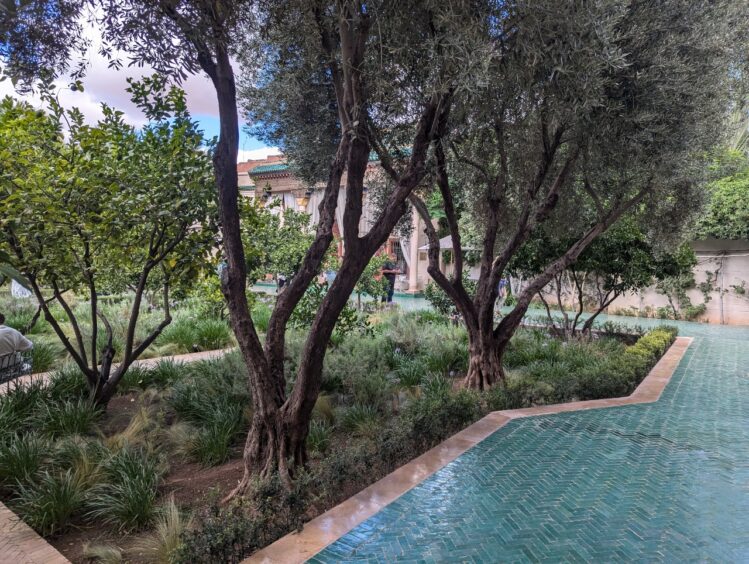
The secret is out, and advance tickets are recommended, but the Secret Garden (Les Jardin Secret) is still worthwhile if you have the time. The traditional Islamic garden is in the heart of the medina. It’s incredible to see how quickly you can forget the madness in the busiest part of the medina just by stepping into the garden.
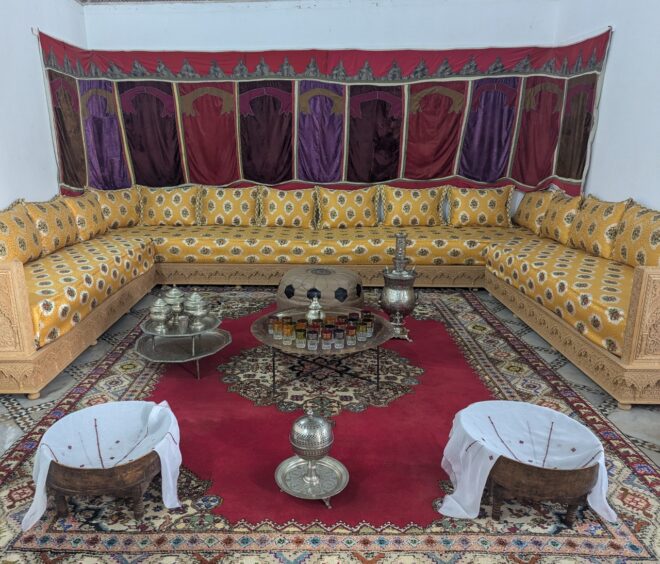
We visited two palaces near our riad. Bahia Palace was so very crowded that I had a hard time focusing on the elaborate tile work in the many rooms that surround a large courtyard.
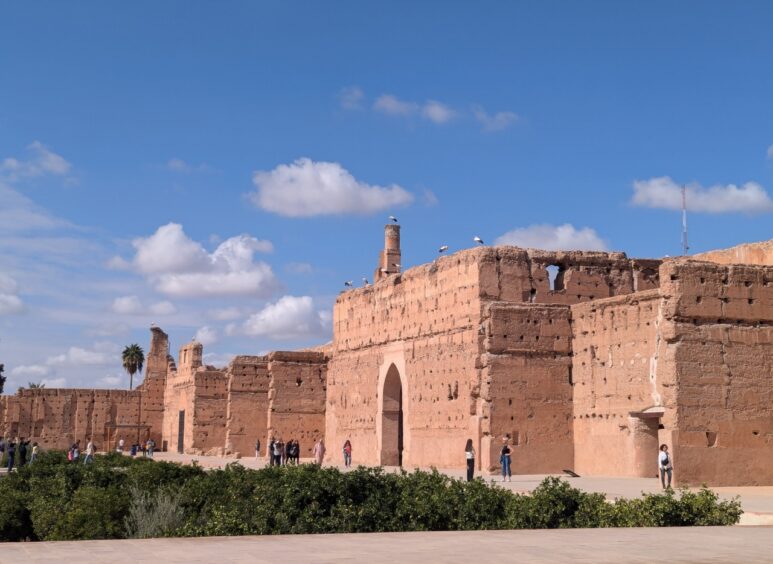
Badi Palace was much older than Bahia Palace, and many of the valuable materials such as marble had been stripped away. To picture it in its prime we had to use our imagination, but the enormous space under a immense expanse of sky was uplifting. In contrast to Bahia Palace, there was plenty of room to roam around freely with fewer people. I enjoyed the experience more as we strolled around large pools of water and gazed at neat rows of sunken orchards.
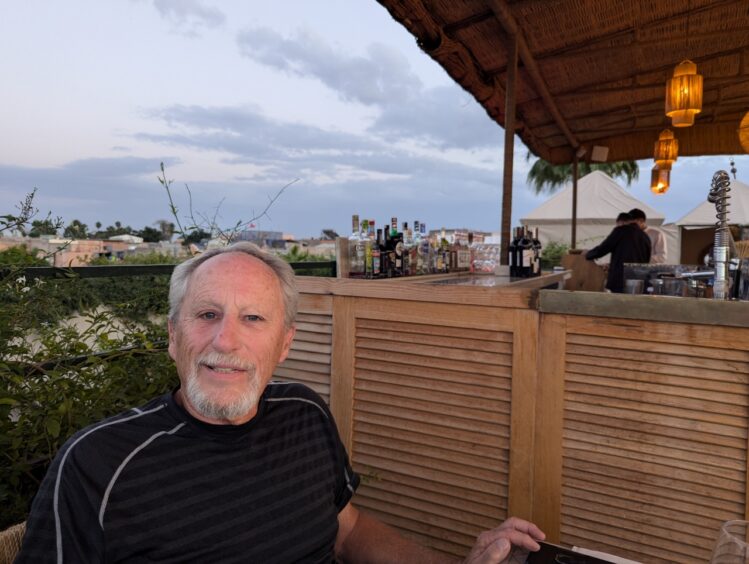
We were happy to settle in for a four-day stay at the Riad Lydines, one of several riads in the Angsana Heritage Collections (an Accor property). Having a ground floor room meant we didn’t have to negotiate multiple levels of narrow staircases and enjoyed a large room with a sitting area. This was one of the smaller riads we had stayed in, with a few dining tables where breakfast was served and a small pool in the open-air courtyard.
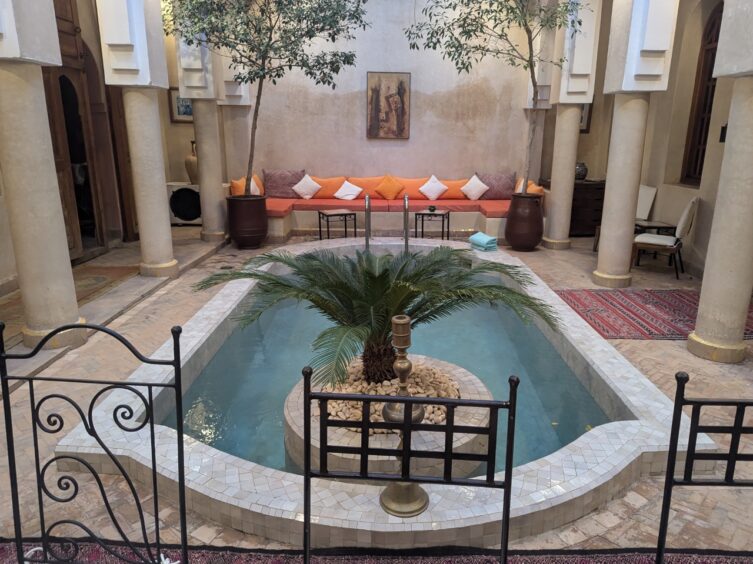
We enjoyed all the lodging establishments and chose to stay in riads in the medina of each town. On our previous visit we had stayed in a mix of western hotels and riads. The riads were charming and gave us a sense of what family life might have been like.
The structure facing the street is often non-descript with nothing but a door, but once inside, the compound takes on a life of its own with balconies on each level looking over an open-air courtyard where meals are taken, often with a small pool of water. All of the riads we stayed in had private baths and on-site staff. All provided breakfast and some had restaurant service for lunch and dinner.
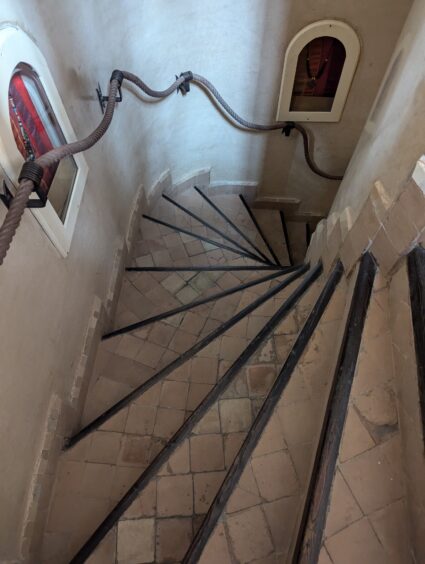
Some agility is required to negotiate narrow passageways, steep steps, and optional handrails. If mobility is an issue, request a ground floor room or opt for a western-style hotel. Many European and American brands have lodging in the major cities, though they are usually located in the modern downtown areas, rather than the medina.
We booked our riads through Booking.com for Tangier and Marrakech, while Berber Camp Merzouga provided our driver and arranged for lodging in Chefchaouen and Marrakech.
We traveled by ferry from Tarifa, Spain to Tangier to start our Marrakech adventure and flew from Marrakech to Frankfurt at the end.
I left Morocco more in love with the country than ever. Our relaxed itinerary allowed us to explore at our own pace and absorb the myriad cultural influences that make Morocco so complex and alluring. Our 10 days in Morocco on our road trip from Chefchaouen to Marrakech gave us an opportunity to taste our way through the country while learning more about the history of what makes Morocco special.
Morocco: https://ingasadventures.com/category/morocco/
 Previous Post
Susan Alcorn says:
Wow! I really enjoyed reading this as our first-time trip to Morocco is coming up soon and I am very excited to begin. We will be with a tour group, but I know we will visit many of the places you mention. Your photos are stunning! I remember being in southern Spain standing across the Strait and wishing we had allowed time to take the ferry over–so now we have the time. Question: I saw that you mentioned dress–a long skirt and a long-sleeved blouse. But I saw that you sometimes were wearing a short-sleeved t-shirt. So, as I am choosing what to take, I wonder if I need to always keep my upper arms and knees covered? And what about head coverings? And the shoes–if we had soft scuffs, like you get at a massage parlor to pad around in, could you slip them on when taking off your shoes? It is so timely to receive this story as we are getting ready to visit this beautiful country. Thank you so much! Your stories and photos are always top-notch!
Inga says:
Thanks so much for your comments. I dress conservatively but it’s not as strict in Morocco as some other places. I was most comfortabe with my shoulders covered and skirts to my knee or long pants. No need to cover your whole arm. I don’t recall having to remove shoes. I carried a scarf with my but I don’t think I ever used it–for some temples you might. I usually wear short sleeves and long, loose pants. I have an article on this. Have a wonderful time.
https://ingasadventures.com/how-to-dress-in-morocco-india-and-other-conservative-countries/