


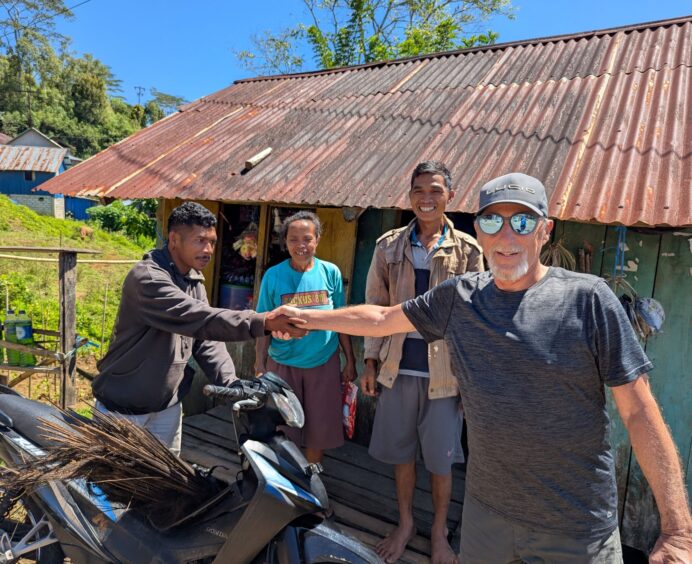
The proprietors of a roadside stand came out from behind the counter to shake our hands when we said we were from America. Then we shook hands with a passing motorcyclist who had stopped to find out what was happening. Apparently, it’s a big deal to meet Americans near Ruteng on Flores Island in Indonesia. Kids laughed good-naturedly, shouting “Bule, bule,” meaning foreigner, to alert their friends. Children clung to Cindy, admiring her light curls, since straight dark hair is the norm. These are the images I carried home. The kind of interactions that cost nothing and created small moments of connection with waves and hellos.
The snorkel trip on Samara 1 was a luxurious peak experience that opened up an underwater world. But it wasn’t how the people lived. I couldn’t leave Flores without exploring more about the lifestyle. Once I saw the potholed condition of the roads, I was glad I was glad we hadn’t committed ourselves to long stretches of highway travel.
This was the first place on our tour through Indonesia, that I hadn’t been to. Therefore, I wasn’t drenched in nostalgia, but I knew it was a favorite of my mother’s. I read through some of her travel articles from the 80s, focusing on Flores. I hoped that in Flores I’d find the Flores she described, where the way of life was relaxed.
A Note on the August 2026 Earthquake. On August 15, 2026, a magnitude 7.7 earthquake struck off the coast of Flores, Indonesia, causing significant damage in Ruteng. Labuan Bajo was less affected. If you’re planning a trip to Flores, check with your tour guide or lodging for current conditions.
We had planned a bigger loop, but the snorkel trip ate up most of our allotted time for Flores. We scaled back to four days in Ruteng. Our guide, Filan, helped us put the itinerary together (see more about Filan below).
My primary goals were seeing the spider web fields, Liang Bua Cave (aka Hobbit Cave), along with some trekking and a visit to a traditional village. I had to further modify the plan once I got there because of persistent vertigo, but we hit the main sights and had time to get a feel for the rhythm of the area. What a bonus this turned out to be.
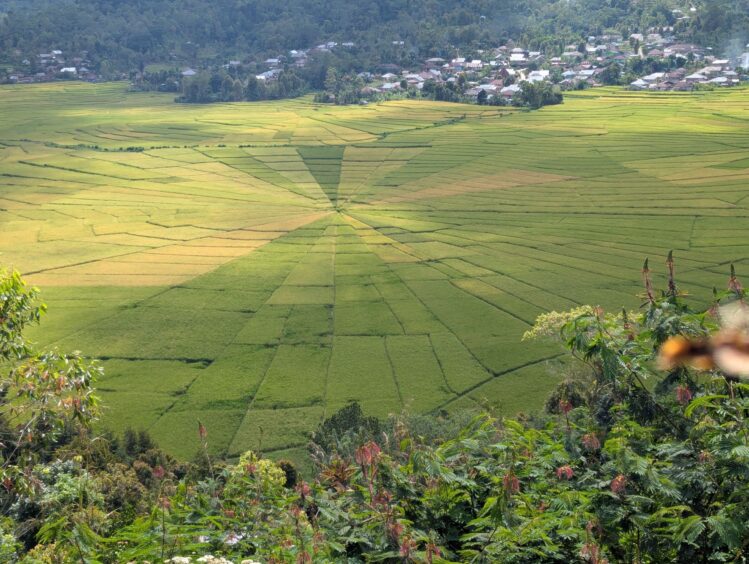
Our first stop on our way into town was an impossibly green spider web rice field. We pulled up to a simple house with a social trail going up the hill. I heard a man call out to someone. A young girl, still in her school uniform, appeared and after talking with Filan, guided us up the hill and showed us around. There was no kiosk or ticket to be purchased, though we gave her some money. It was all very relaxed and informal.
A long time ago, indigenous Manggarai people created the spider web design as a fair way to divide ancestral lands among the people. The communal system radiates from a central point called the lodok where they carry out rituals related to community cooperation, planting, and harvest. Family size and status influence the size of the wedges, and Filan explained it might also have been a fair way to spread access and risk between areas of varying soil and water quality and share the risk in less ideal conditions at the outer edges.
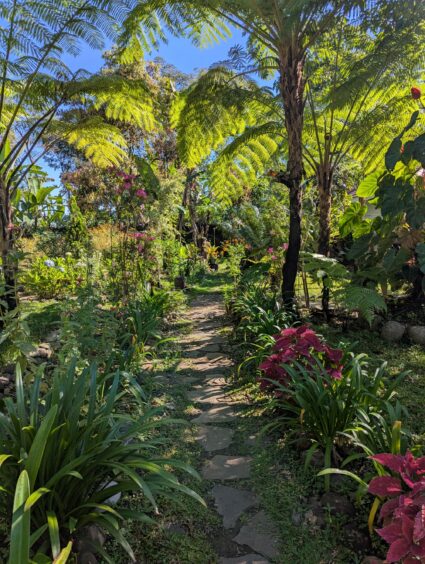
The best thing about the Ara Garden Inn, at the edge of town, was the garden. Built on the slope of Mandosawu Mountain, the property backs against thick vegetation above a burbling creek. The garden, though not large, came alive with the sound of cicadas and frogs. I would wander out of our room and just stand there, listening to the ebb and flow of the insects as I admired a flower or two. The song fell softly when I moved, but if I stayed still, it rose to a fever pitch with clicks, chirps, and trills from other insects and birds.
I had thought we’d do a proper trek of six to eight miles on the Golorenda Walking Trail, thinking it would be cool enough and that I would feel well enough. Luckily, Filan was flexible and attentive when I needed to slow the pace. A couple of his friends, Sylvester and Ronald, guided us on the hike. He stayed with the car, ready to pick us up whenever we were done.
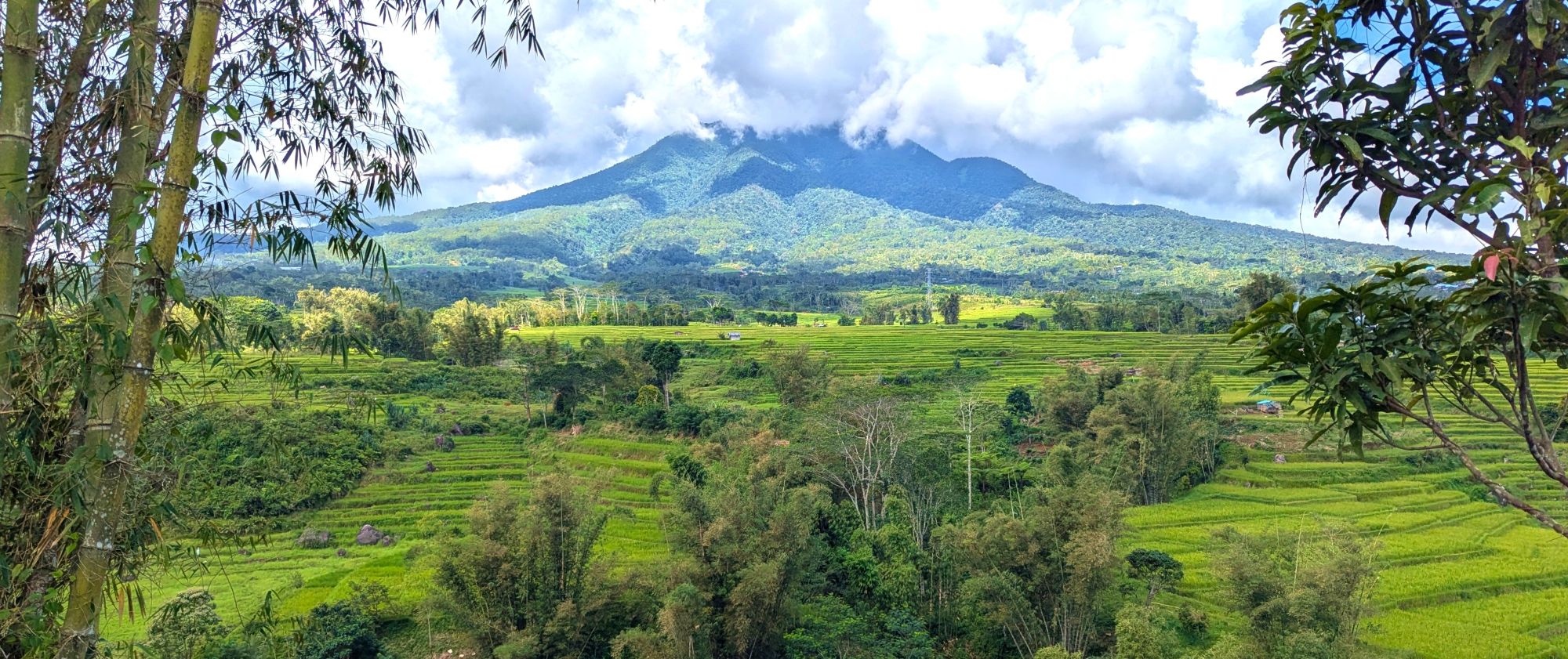
Although Ruteng sits at around 4000 feet, it was still warm and humid. A few miles of trekking left us sweating profusely and was enough to give us an idea of the pleasant single-track path that connected fields, overlooks, and villages. The scenery was stunning, with distant green hills and higher volcanic mountains forming a stunning backdrop.
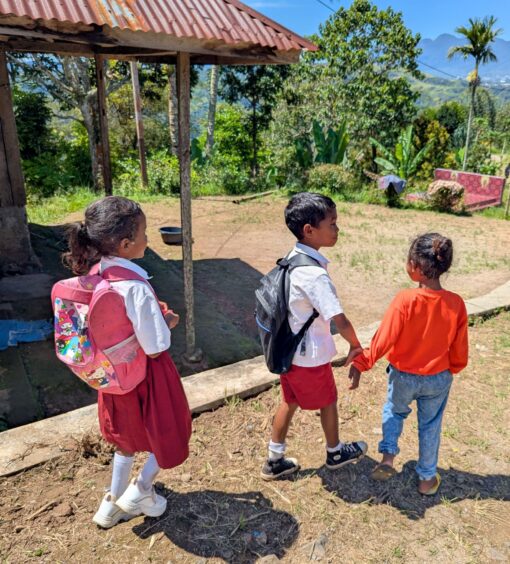
We walked with villagers striding purposefully to distant places who fell in with us for a time. Seemingly, everyone on the path knew our guides, and jovial conversations ensued. We also picked up gaggles of kids coming home from school who giggled every time we looked at them. Some chickens and goats completed the scene. I noticed people were focused on their work. Yet they were unhurried whether it was doing laundry, working in a field, or walking to the next town. They always had time to pause and have a chat.
We were happy to stop at a house in one village to see how they make their pandanus mats (see next section), and after that, we happily ended the hike and had lunch, satisfied with the excursion.
In hotels in Labuan Bajo and Ruteng, as well as in restaurants, we admired the woven fabrics and mats. I asked Filan if we could observe weaving techniques or find handicrafts. Unlike Bali, with hordes of tourists, there were no handicraft centers or scheduled weaving demonstrations, though Filan can arrange these in advance for those with a special interest in ikat weaving. He was, however, able to use his contacts to arrange a demonstration of mat weaving.
Filan cleverly wove this into the trekking experience. We veered off the walking track down a street of modest concrete homes, each with a tidy yard and clean porch. Children flowed in and out of the homes, roaming around in a friendly pack, the older kids pulling the younger ones along.
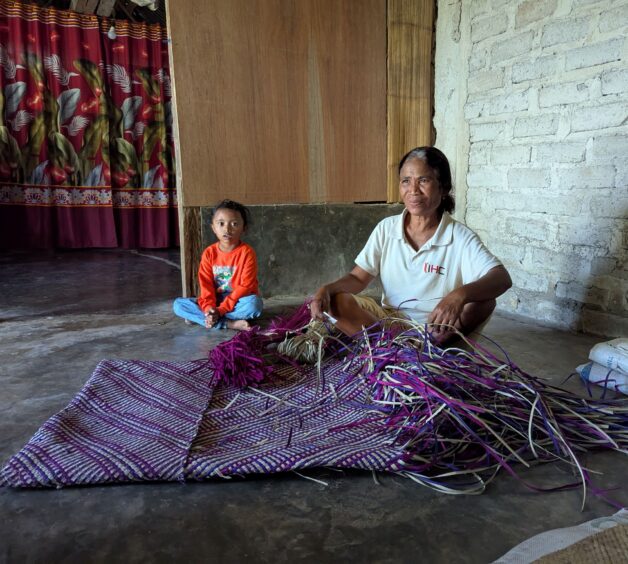
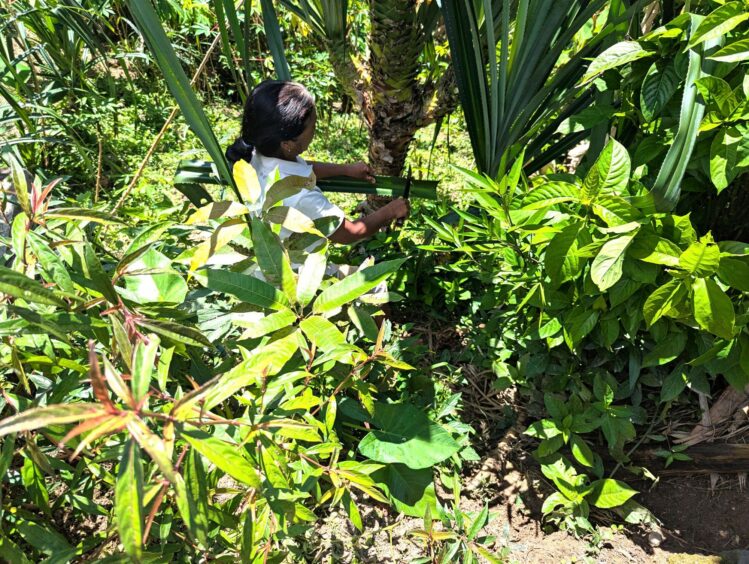
We met an older man and a middle-aged couple, shaking hands all around. The woman picked up a machete and led us across the street lined with pandanus trees. Wielding the machete expertly, she shaved off a few branches. Returning to her front yard, she used the machete to shave each branch into thin strips. We listened attentively as she explained, with Filan translating, that the leaves go through several rounds of boiling and drying in the sun over four days until they are pliable and dry. Leaving the green ones in the yard, she led us back inside her home, where we sat on a finished mat while she resumed work on a partially completed mat. I loved watching her confidence as she deftly manipulated the dried strips to create a pleasing design using natural and purple-dyed strips.
Reports of tiny humans drew me to the Ling Bua Cave. The discovery in 2003 of the bones of a small human intrigued me and rocked the world of anthropology. First thought to be a child, the body that measured just 3.2 feet (one meter) tall turned out to be an adult of an intermediate species of the Homo genus—not quite human but more advanced than apes. Homo floresiensas captured the imagination of the public as the more colloquial Hobbit people.
I was so intrigued by the Hobbit Cave, I assumed it would be a big draw. Without Filan, we might have driven right past it. The unobtrusive site lacks prominent signage or infrastructure, though it’s protected by government decree. The limestone chamber is visible from the road but blends in with the lush vegetation covering the hilly land. There were no parking lots, coaches, mandatory guides, or tickets. We ambled up to the site and marveled at the scene. We were the only ones there.
I know our guide covered any fees, but the arrangement seemed loose or based on the honor system. It’s best to get a local guides are recommended to explain the significance—otherwise it would be easy to be underwhelmed.
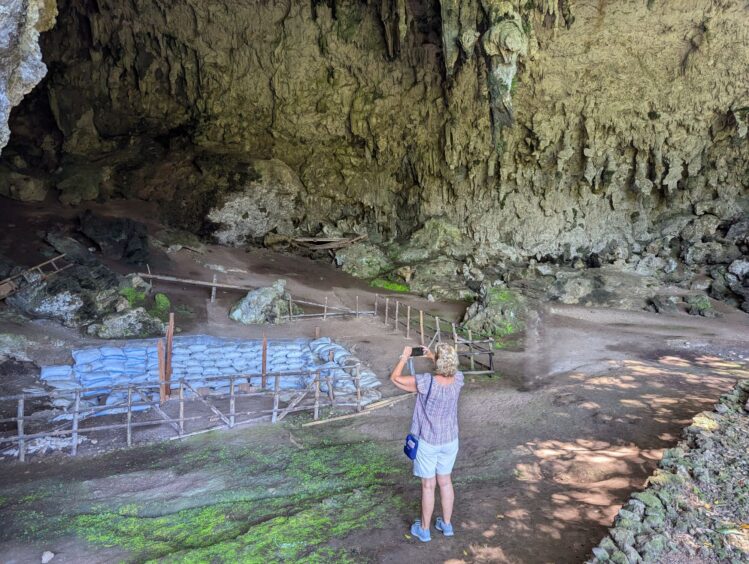
Sandbags lined the deep chamber, 19 feet (six meters) deep, where the fossilized bones were excavated. I had a hard time imagining the actual size of the bones, but Filan reassured me that we’d learn more at the museum nearby. It was easy for me to stand in the cave imaging small humans taking shelter from the elements here.
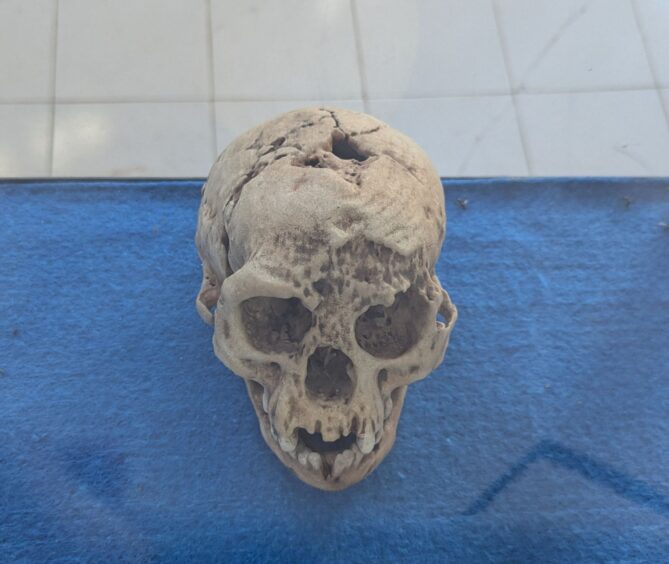
It was only a short distance along the road to a small building that housed the Liang Bua Museum, but it was enough time to collect a few kids trailing behind, while one grabbed Cindy’s hand and wouldn’t let go.
Replica casts of the skull and bones made the site come alive, along with renditions of what the Hobbit people might have looked like. The interpretive signs provided a context for the unusual environment at the time. Fossils of an enormous marabou stork nearly twice the size of the Hobbit people (5.9 feet/1.8 meters) were discovered nearby. These, along with pygmy elephants no bigger than cows (now extinct) and 330-pound Komodo dragons (still roaming) revealed a place of natural extremes, like a carnival house of mirrors where everything is exaggerated. I wondered if the diminutive people interacted directly with modern humans. No one knows. Unlike in the movies, where laboratory results are crisply defined, dating techniques thus far have presented a muddled timeline.
In the meantime, the small child remained attached to Cindy, and we were sad to say goodbye.
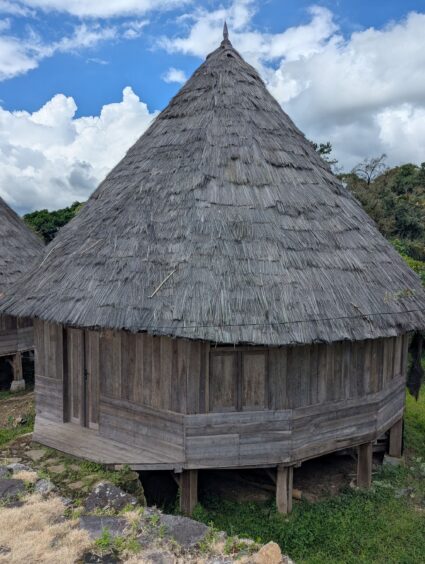
The Ruteng Pu’u Village, a traditional Manggarai village outside Ruteng, was the most tourist-focused activity of the trip, and even this was laid back. This is one of only a few remaining traditional villages and had the feeling of a lived-in place rather than a museum. After paying a small fee (less than USD $5), a villager helped us wrap a sarong around our lower bodies and provided a colorful woven headband for the ladies and hats for Steve and Filan.
The thatched houses fascinated me with their extreme height, reaching five stories to the sky before coming to a point. Filan described the construction of the round houses and the role of the chief as he led us to the chief’s house.
We shook hands with the chief’s wife, who prepared coffee and tea for us. Sitting on pandan leaf mats like the ones we had seen demonstrated on our trek, we sipped our hot beverages as she described the parts of the house. The ground floor had bedrooms behind curtains and a large open space. A kitchen was in a room at the back of the round house. I was fascinated to see how ancestor worship coexisted alongside Catholicism as I looked up into the rafters. Tribal ceremonial objects hung above the living quarters in a large airy, open space, while posters of Jesus hung on the walls.
With Filan translating, we had a relaxed conversation with the matriarch. She asked us some questions about where we were from and answered all our questions about how food was prepared for festivals, the weaving that the women did, and the preparation of the palm wine. I realized the importance of the central space in the village when she explained that during festivals, the spirits are fed first by placing offerings on the compang, an ancestral stone altar.
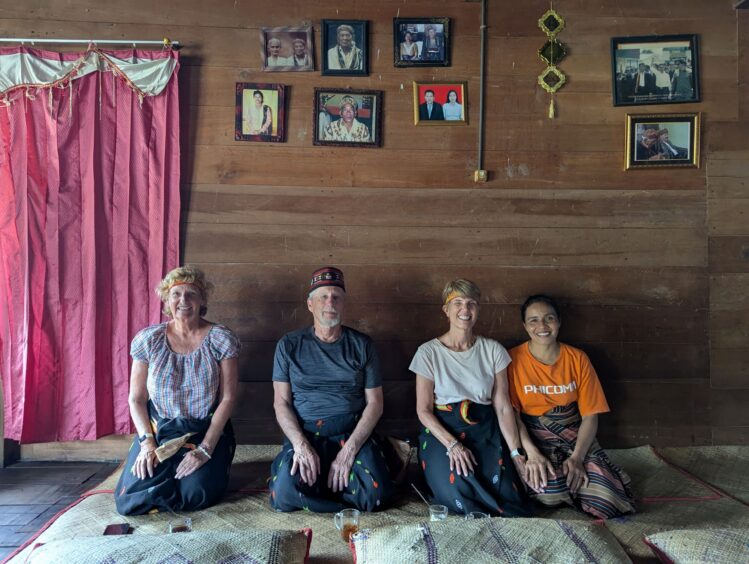
I felt honored to have tea with the first lady of the village and held my breath in wonder as she took my hand in hers when Filan took a group photo. We were two women from different worlds, speaking different languages, who shared an intimate moment of connection.
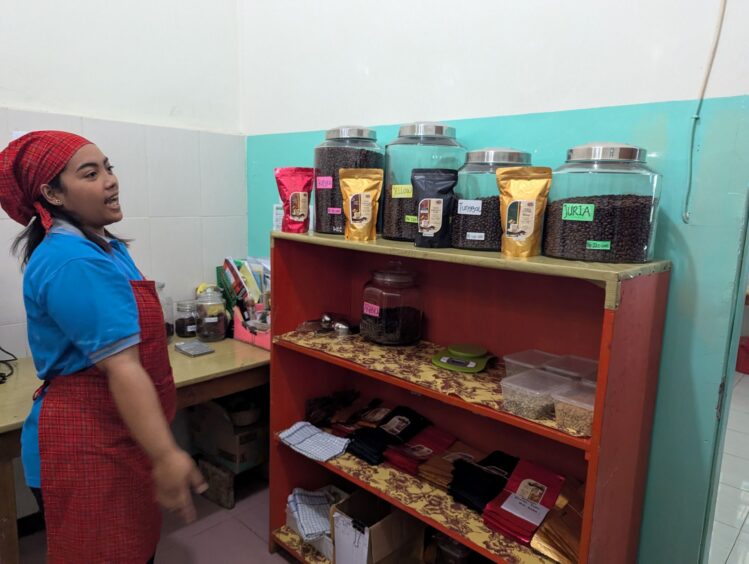
On our last day, we asked Filan if there was any place to buy woven goods or souvenirs. It’s a testament to how few tourist-focused places we visited that we hadn’t purchased a single thing besides food. He thought about it and eventually took us to the Good Shepherd Sisters (The Congregation of Our Lady of Charity of the Good Shepherd), a Catholic order that runs a mission to aid vulnerable women. This exposed a gap in the deeply patriarchal society. The rhythm of village life works when there is a male head of the household, but breaks down for single women. Women who are single because of divorce, death, or abandonment face social and economic hardship. We were pleased to support the sisters who provide shelter, vocational training and counseling with small purchases.
The grounds were lush and tranquil, despite the air of activity and purpose. One sister showed us a coffee mill where they process beans, inviting us to try a sample of delicious coffee. After a brief tour, she escorted us to a small gift shop where we could finally satisfy our craving for souvenirs. We happily debated different woven designs and purchased purses and coffee to take home.
The evidence of strong Catholic faith and the churches we saw reminded me of a conversation I had on the snorkel trip. When one of the crew from Ruteng showed me photos of his town, I noticed a lot of church steeples. Knowing Indonesia is 87% Muslim, I asked what percentage of his town was Christian.
“100 percent,” he said proudly. I was reminded to check my assumptions when traveling to new islands and in doing my tardy research, I learned that it’s actually around 90% Roman Catholic. Behind all those steeples, though, is the harder story the Good Shepherd Sisters showed us, of women who fall through the cracks when the social structure fails.
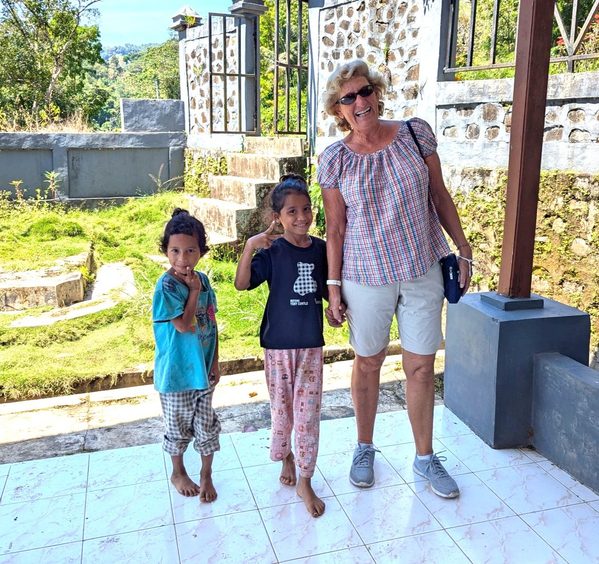
In the end, my minor illness slowed us down enough to appreciate the rhythm of Ruteng. Nothing was rushed, and our encounters felt natural and personal, as if children and adults invited us in rather than acting as observers and observed. Filan’s role as ambassador of his city and friend to all made it seem like he was introducing us to his community as friends from America. We got to see their culture as they are living it.
It was the perfect transition to our next stop in Raja Ampat.
The best time to visit Flores is in the dry season, April to October. The shoulder seasons can be acceptable, but peak rainy season, November to March, can brin heavy downpours.
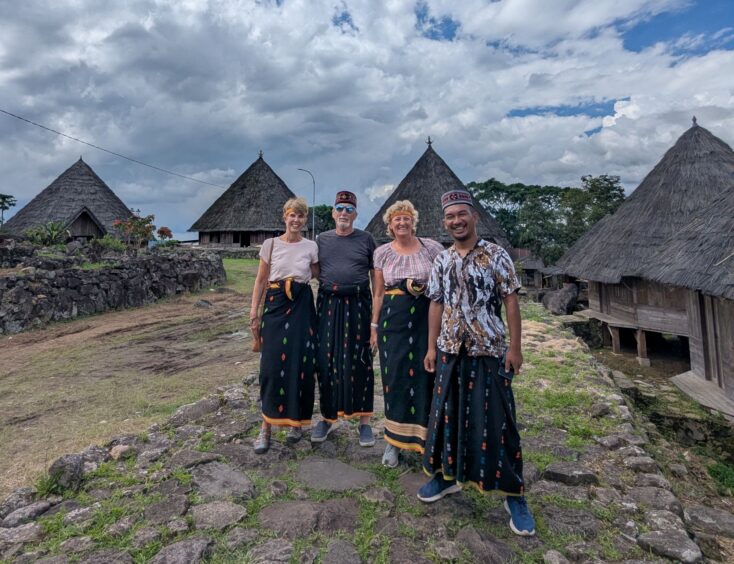
We found Filan using a strategy that has served us well. My husband found Filan Travel Service on TripAdvisor, noting that he had many positive reviews. This is a good first step. I checked his website, which was comprehensive and professional in appearance. When I messaged him on What’sApp, he responded right away. These were three positive indicators that we was legitimate, but we really lucked out. His English was excellent and he drove a nice, air-conditioned car with functioning seat belts. He lives in Ruteng with his wife and children, whom we met. And he is a leader in his community, well-known wherever we went.
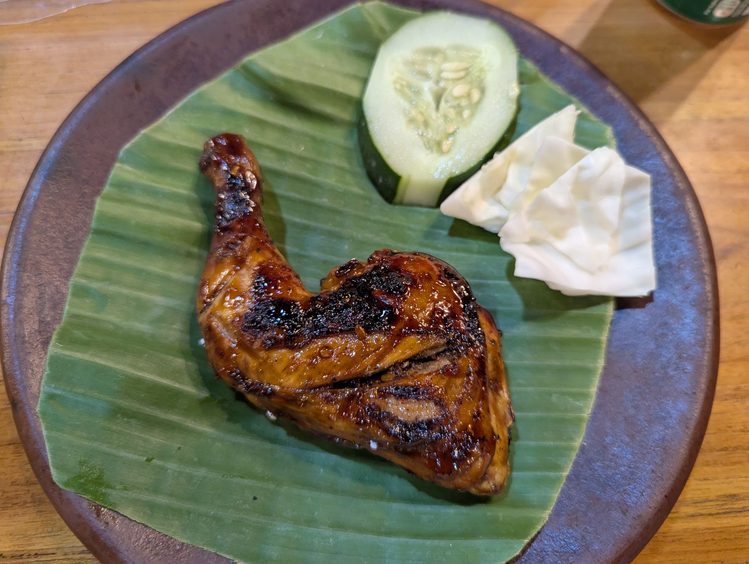
The food in Ruteng was simple and basic. It was common to find a limited menu, such as chicken or fish prepared several ways. We ate a lot of rice with grilled or friend chicken, usually leg and thigh. On our last night, we were excited to find cumi-cumi (squid) in a delicious sauce. There’s not a big foodie scene here, just basic food prepared expertly.
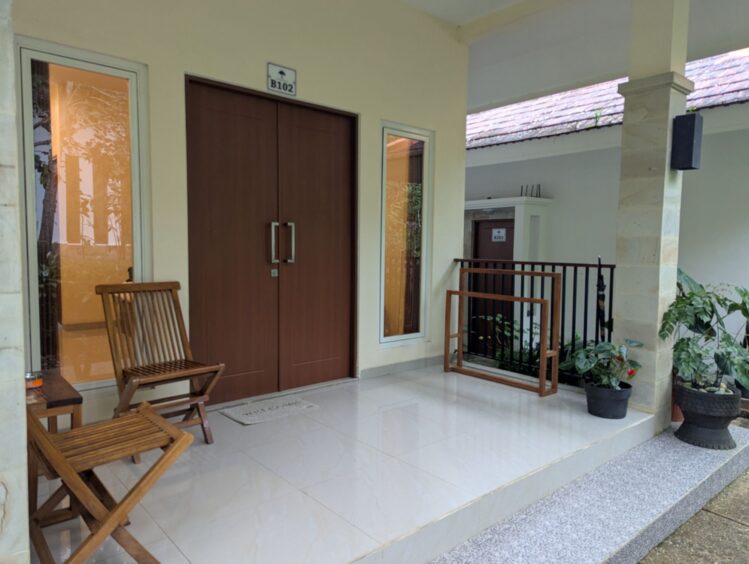
Filan recommended the Ara Garden Inn, which was perfect for us. This ecolodge uses solar power and reuses wastewater to water the gorgeous garden. The room was spacious and clean with good Wi-Fi and plenty of hot water. It’s an intimate space with just four rooms and a couple of tables on the patio facing a bamboo forest where meals are served. A large room in the main building serves as a yoga studio. They offer cycling tours, birdwatching, yoga and spa services.
The extensive grounds at the Spring Hill Bungalows, where we had a good lunch one day, looked inviting, though I didn’t see the rooms.
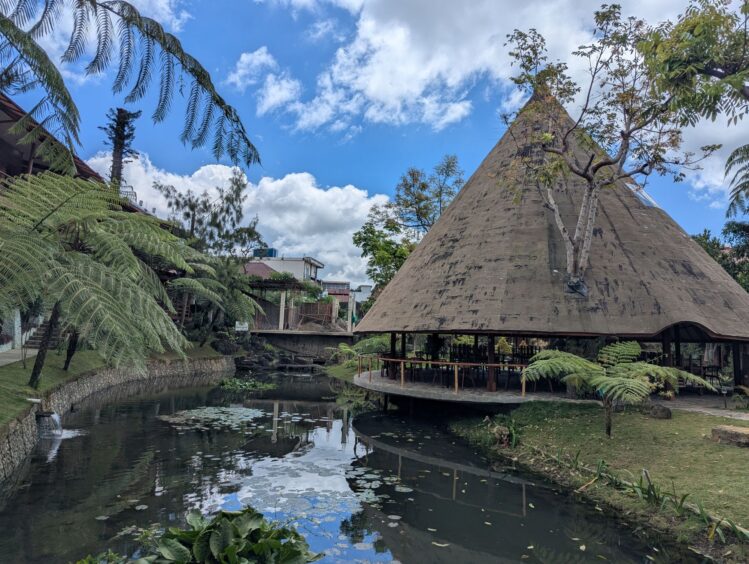
There are no western chain hotels, but there are some small hotels and many homestays. Prices range from $30-100 per night.
There are several flights a day from Jakarta (Java) or Denpasar (Bali) to Labuan Bajo (Flores) on Lion Air, Batik Air, and Garuda. Flights are available from other cities in Indonesia as well. From Labuan Bajo, it’s a four-hour drive to Ruteng.
 Previous Post