


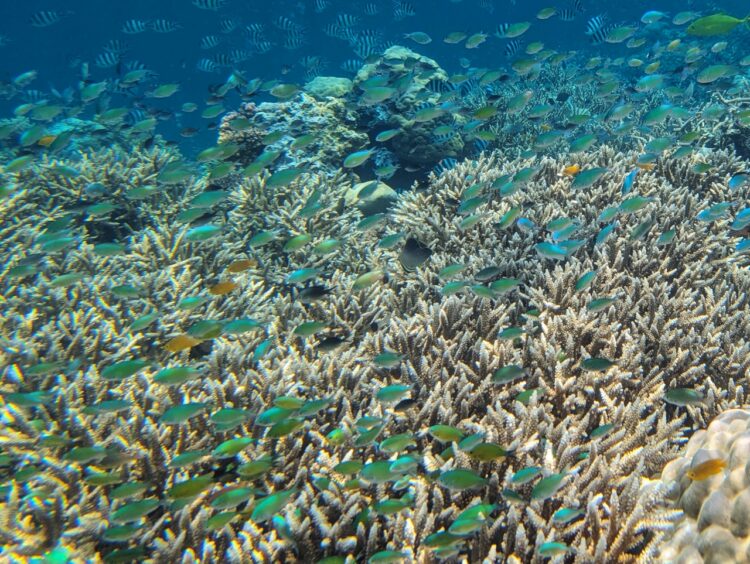
“Come quickly. It’s a …,” shouted the snorkel guide, the name of the creature swallowed by the wind and waves. Not that it would have meant anything to me. I didn’t know the names of anything nor what they looked like. Dutifully, I put my head in the water and started stroking toward him. But suddenly I found myself in an enormous ball of silvery fish, catching the filtered sunbeams like a million points of light. Was I underwater or in outer space? It didn’t matter—it was wondrous. Motionless, I held my breath as long as I could, wanting to remember the moment forever, the guide forgotten.
I was bobbing in the Flores Sea near our boat, the Samara 1. My husband, Steve, and my best friend, Cindy, paddled nearby as we absorbed the magic of a liveaboard near Komodo Island in Indonesia. We were on Week Three of a month-long visit to Indonesia and were ready for a water-based segment after our land based adventures in Java.
Read more about itinerary planning in Beyond Bali: Your Indonesia Island Itinerary Guide.
Being casual snorkelers, we’d normally go out for 30 minutes and call it good. What possessed us to sign up for a four-day snorkel boat? I chalk it up to future-self optimism. None of us had ever wanted to do a cruise, and we hadn’t snorkeled in years, but hey, we can do intensive snorkeling for four days. We rooted around in our closets, found our masks and snorkels, and were good to go.
I didn’t even know a liveaboard could be for anything except divers, but we learned that around Komodo Island, snorkeling liveaboards were everywhere. The routine is simple: eat, drink, sleep snorkeling.
Being a half-step behind for every activity on the first day was intimidating. I felt off-balance getting in and out of the tender boat. I had either too much or not enough gear. And my improperly placed mask filled with water the first time I plunged in from the tender boat. Luckily, some of the experienced guests lent a helping hand to steady my step into the boat or grab my snorkel gear when coming out of the water. I learned to ask whether we were jumping from the tender boat or going to a beach. For the former, I just needed my snorkel gear. For the latter, I brought a sarong, hat, sunglasses, and some money for drinks or souvenirs from the beach shacks. And I learned to position my mask and snorkel before I flipped my legs over the side to leap into the water.
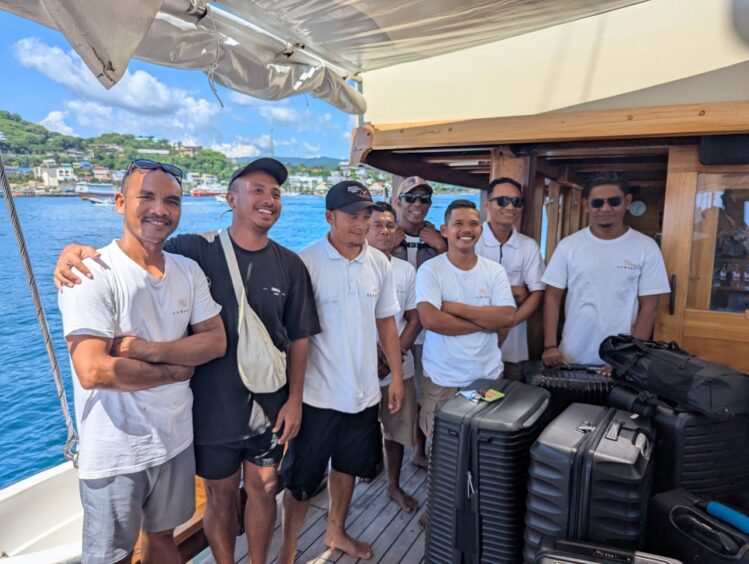
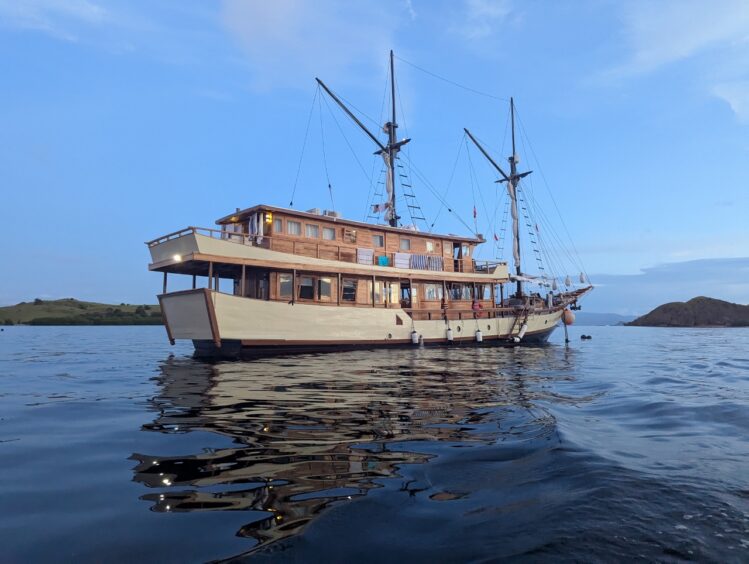
From the water, I admired the Samara 1, a gorgeous phinisi boat with a graceful, curved hull crafted from teak and ironwood. Built to match the traditional lines of the two-masted sailing ships fishers used dating back to the 1400s, it also had all the amenities modern seafarers expect. Solar power, air-conditioning, and en-suite bathrooms with flush toilets made accommodations quite comfortable and quiet. With nine crew members for nine guests (12 maximum in five rooms), the crew attended to every need. Friendly banter echoed around the boat as we all got to know each other quickly. I loved our international group from Australia, Brazil, and Mexico. We were the only guests from the US.
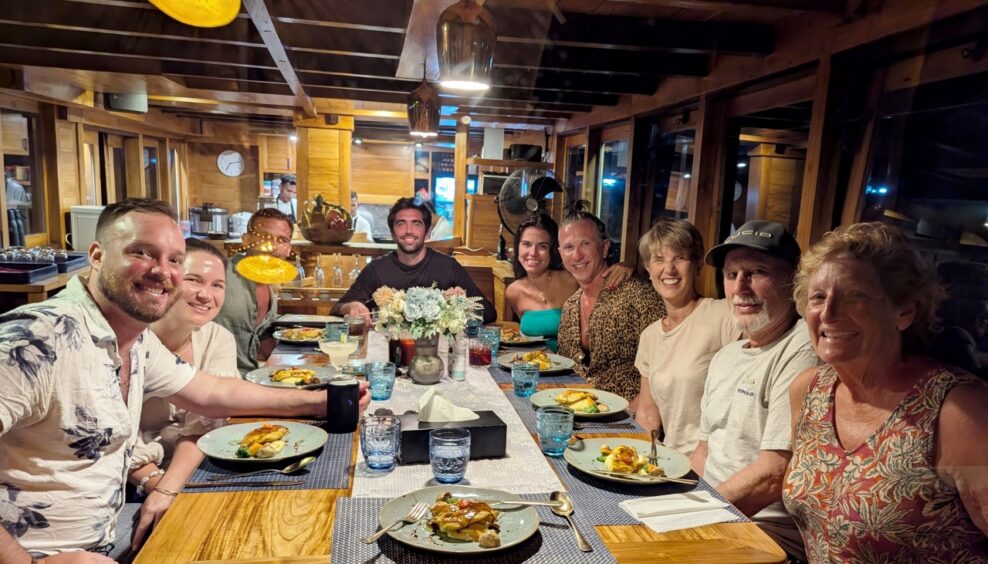
I loved eating together as a group at the big wooden table because we felt like family right away, passing dishes and exclaiming over the flavors. The western-style meals were every bit as delicious as the Indonesian ones, though I always preferred Indonesian food. I can get good pasta anywhere, but I’ve only found tasty Indonesian food in Indonesia. Food and soft drinks were plentiful and included, with a tab running for alcoholic drinks.
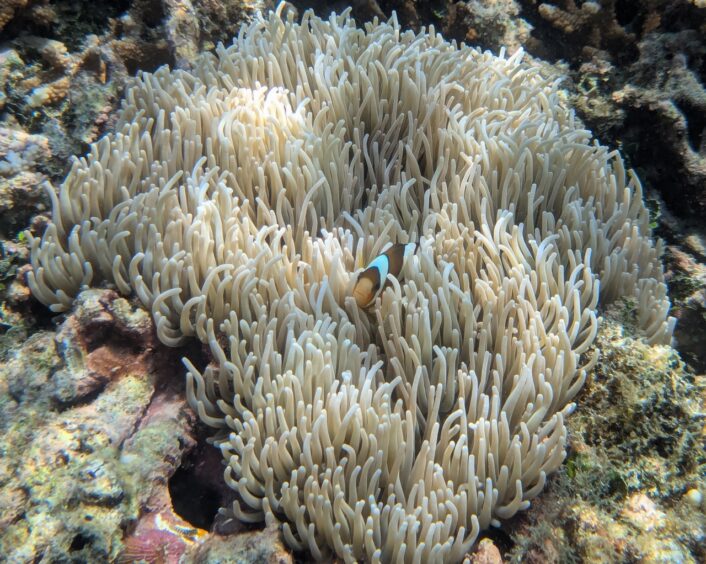
Sadly, I can’t tell you much about the incredible variety of fish we saw every day because, being such a newbie, I couldn’t tell a tiny wrasse from a giant trevally. All I can say is that the density and vibrant colors astounded me. I felt like an intruder who had dropped into an aquarium stuffed full of fish, but with no glass boundaries. I could swim until my arms couldn’t stroke any longer, yet masses of fish were unconcerned with my presence. Others exclaimed over “Nemo” fish (clownfish or anemonefish), parrotfish (I did love their gaudy mix of colors), sweetlips (who wouldn’t love that name?), angelfish, and butterfly fish, but it would take a few more trips before I upped my fish-naming game. I didn’t even use my underwater phone case until the next snorkel trip the following week in Raja Ampat. Therefore, all the underwater photos in this article are from Raja Ampat.
The air vibrated with anticipation when one of the crew yelled “manta ray” and pointed to a splash in the distance. Everyone piled into the tender boat, myself included, though I wondered what all the fuss was about. Snorkelers sprang from the boat in a frenzy that resembled sharks at a feeding station, while I hung back to avoid a collision. Suddenly, a graceful sweep caught my eye. Unlike our frantic, uncontrolled movements, the enormous manta rays were unhurried and unbothered as they rapidly left us behind with their enormous wingspans.
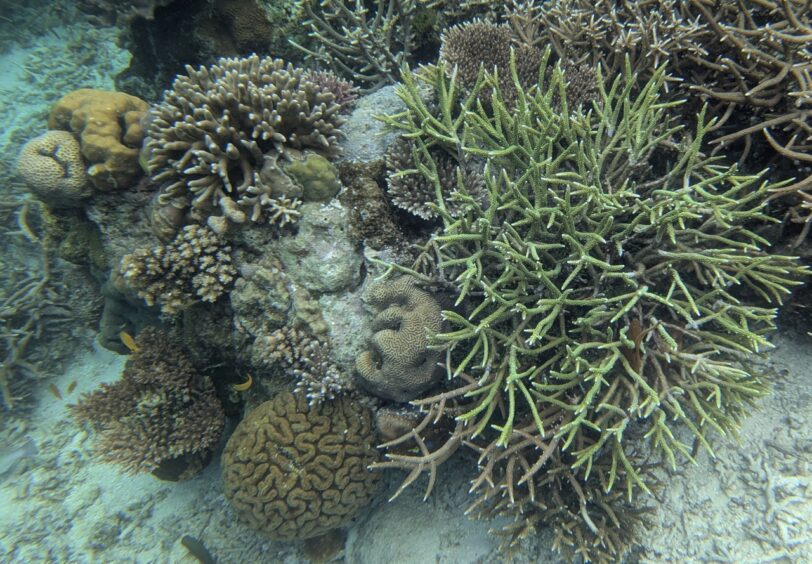
The coral surprised me as well. I had no idea coral came in such brilliant hues, and the shapes defied imagination. They were real, but I kept thinking someone had dropped a bunch of plastic shapes in the water that looked like brains and tubes and fans.
I consistently missed cues from the snorkel guide to look at something special because, to me, it was all incredible, so even the most mundane (to them) fish had me enthralled with their vast numbers or wild colors. If I did join the group to see what wondrous thing they pointed at, I’d often miss it because I had no idea what to look for.
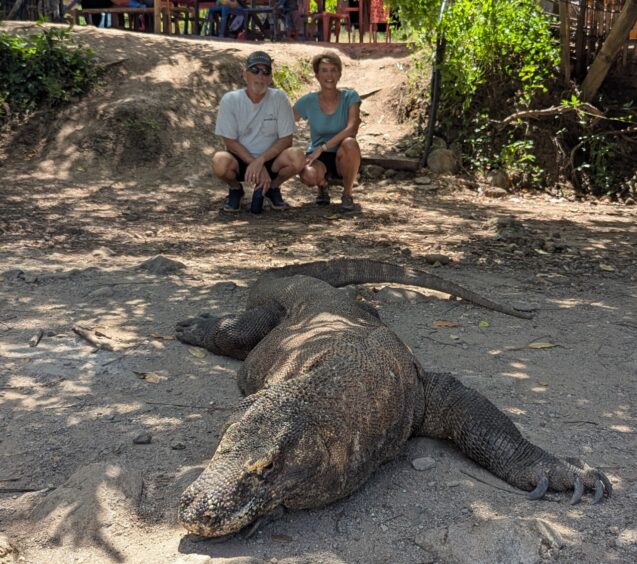
Our interest in the Komodo dragons, an exceptionally large reptile that can weigh up to 330 pounds and live 30 years, drew us to the liveaboard experience. They can only be found in Indonesia and are a big draw for animal lovers. The few islands they live on are protected and the only way to reach them is by boat.
To be honest, with all the underwater wonders we saw, the Komodo dragons ended up being an anticlimax. Instead of the freedom of open water, a guide led us through one of the dirtiest villages I’ve ever seen. Garbage issues are complex in remote areas of Indonesia with a lack of infrastructure and plastics carried on currents, but the Komodo Village was extreme. The villagers were clearly over the tourist influx and didn’t respond to greetings or smiles.
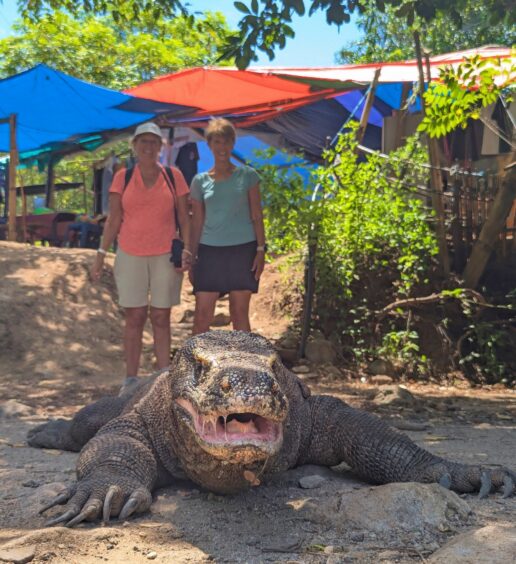
Fascinated, I observed the giant lizards—for about 10 minutes. They sluggishly opened an eye to look at us, then fell back into a post-feeding stupor. We took our photos to prove we had seen them and looked forward to being back on the boat.
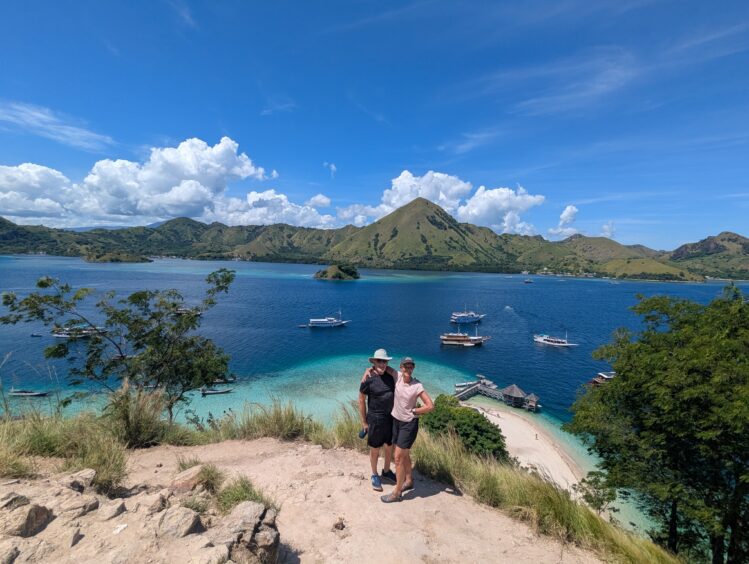
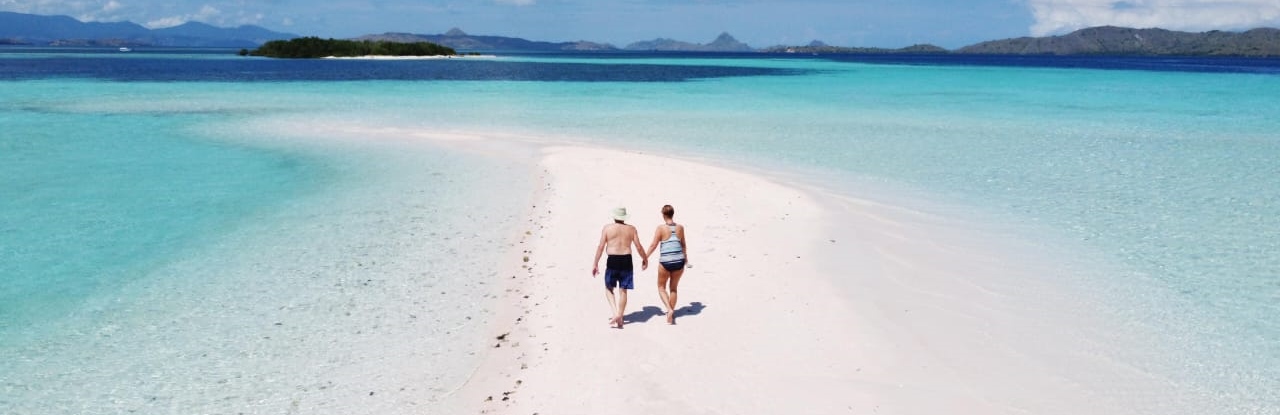
For other excursions, getting off the boat was a treat. On the first day, we did a steep, short hike to a lookout that gave us a panoramic view of many islands with waters shading from turquoise to cobalt blue.
On the second day, most of the guests rose at 5 AM to do a sunrise hike, but our group decided sleep was more important. We also visited two beaches where we could snorkel and play around on the stand-up paddleboards.
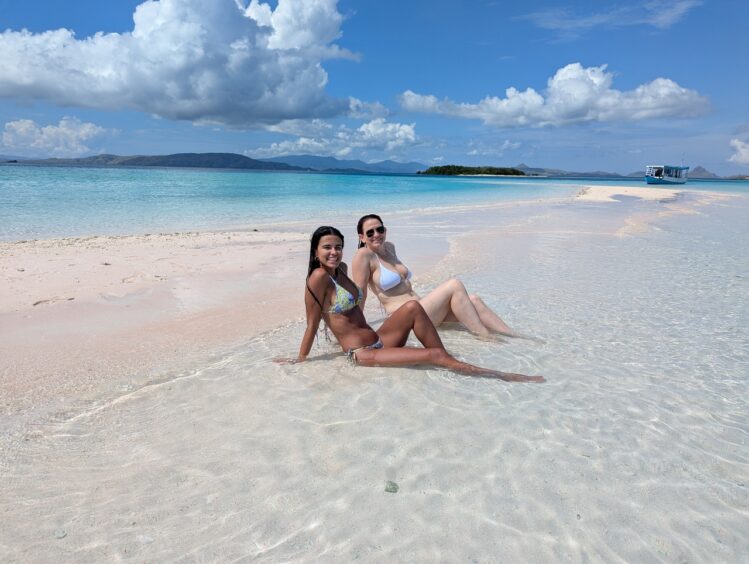
The third day, we frolicked on a gorgeous sandbar in the sea, one of my favorite stops.
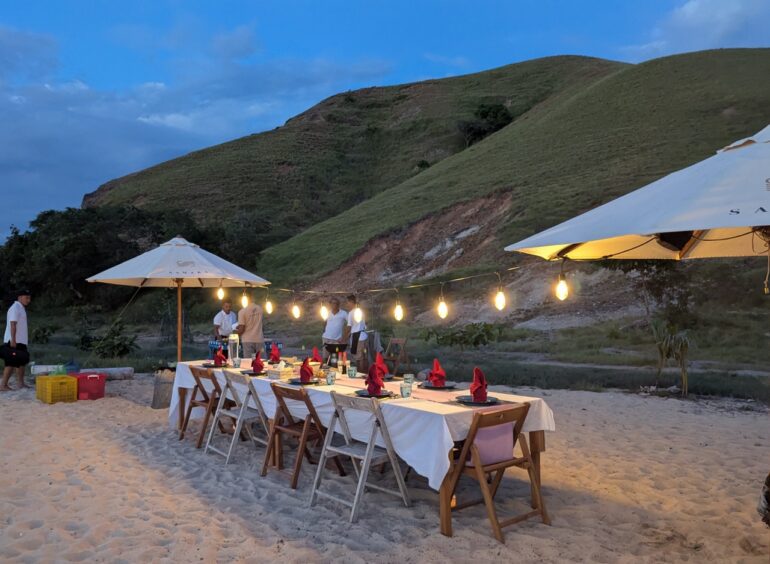
On our last night, we enjoyed a special dinner. Instead of dining on the boat, the crew spent the afternoon setting up a dreamy table under a string of lights suspended between two umbrellas. The elegant scene was set with a white tablecloth, red napkins folded like a tropical flower, and blue plates. The chef hovered over hot coals, barbecuing chicken sate, fish steaks, and giant squid.
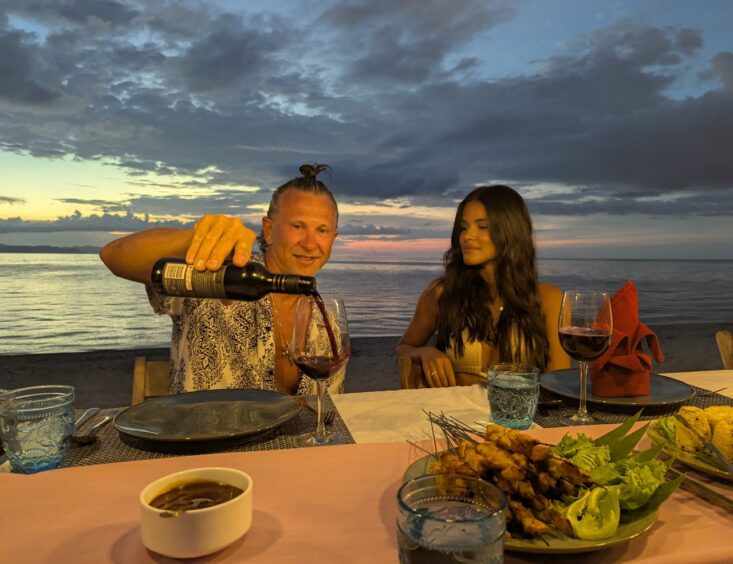
We all dressed in whatever upgrades we could find in our suitcases to match the occasion and raised a glass to the marvelous crew for making it happen.
Getting to the port city of Labuan Bajo in Flores is straightforward, especially if you’re planning to visit Bali. There are multiple flights a day from Bali, and direct flights are also available from Jakarta and Surabaya.
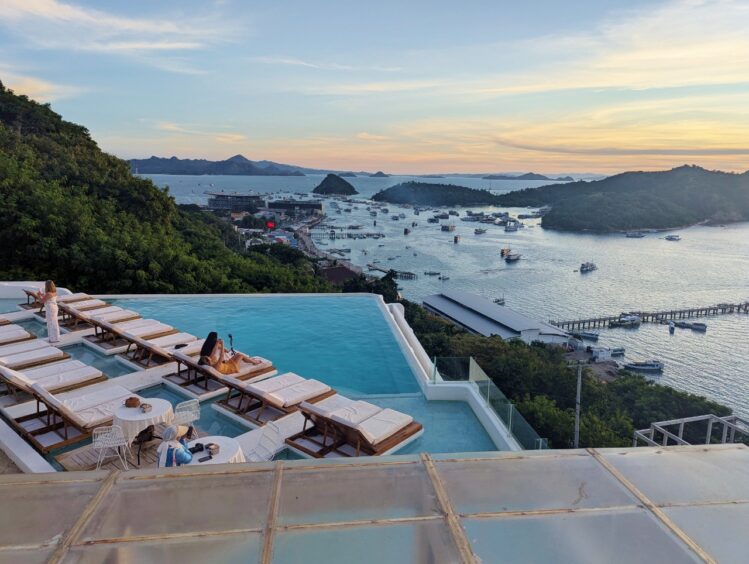
Labuan Bajo is a small town, but because of the popularity of Komodo-related activities, there are many hotels and several restaurants. Our hotel, Loccal Collection Hotel, featured gorgeous views of the bay from the pool, bar deck, and many rooms.
To extend our Flores trip, we arranged for an overland trip to Ruteng after our liveaboard experience. Stay tuned for my next article to read all about it.
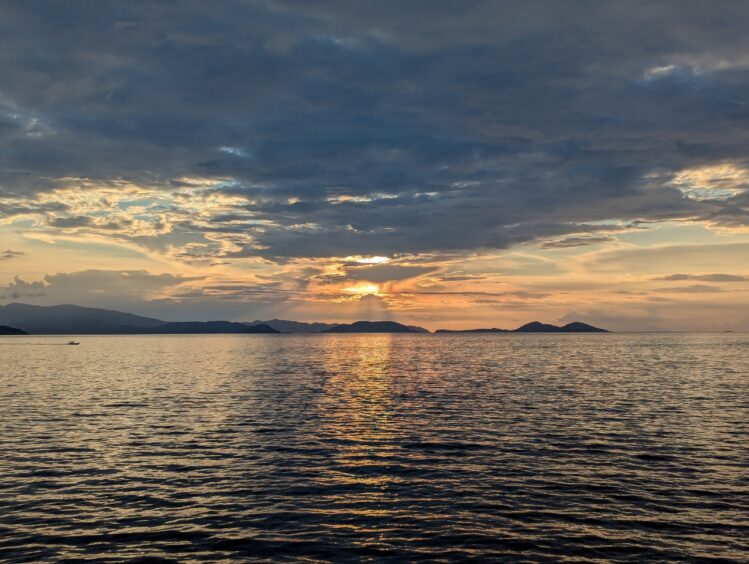
The Samara 1 Liveaboard is the perfect starter trip for anyone curious about liveaboards. It’s a great way to expand what you’ll see besides Komodo Dragons and the logistics are straightforward. Now that we’ve done a few intensive snorkel trips, I always recommend a Komodo area liveaboard like the Samara 1 to start with.
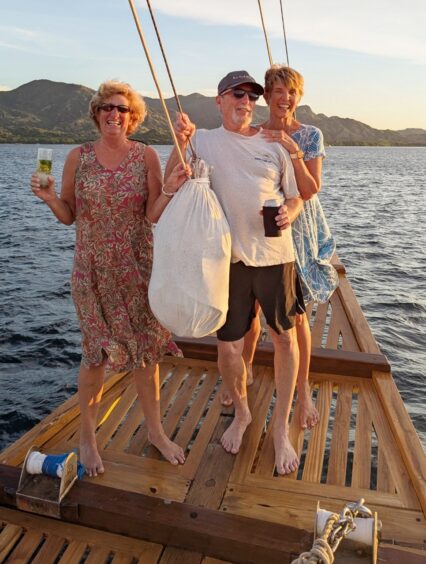
Photos by Inga Aksamit and Rangga, the Samara 1 crew photographer (with permission).
 Previous Post