Hotels in Hong Kong


Hotel de Edge

Hotel de Edge, Hong Kong (Steve Mullen)

We stayed in 2 hotels in Hong Kong as it was a bit challenging to find rooms due to the humongous jewelry show that was going on. Both the Hotel de Edge and Courtyard by Marriott were located in the Western District adjacent to the Central District, and were both sleek and modern. Rooms in each were characteristically small as space is at a premium in Hong Kong, but very well appointed. The Courtyard in particular is like no Courtyard in the U.S., being more akin to a full service Marriott in the states. In the Hotel de Edge we had a fantastic view of Victoria Harbor, while at the Courtyard we had a view of Victoria Peak, partially obscured by other high rises. You can read my review of the Hotel de Edge on Examiner.com or Trip Advisor.

The primary business in the Western District is dried fish commerce so the area is tinged with the faint odor of seafood, pungent but not unpleasant. The open front shops provide many photo ops, with stacks of unusual dried seafood, which is used to flavor many dishes. Getting to the Central District, which is the financial nerve center of Hong Kong, is easy on the historic double decker trams that trundle across the entire waterfront all day. In general, rates are a bit less dear in the Western District compared to Central, and I prefer to be on Hong Kong Island rather than Kowloon.


Peninsula Hotel

Inga in front of the Peninsula Hotel (Steve Mullen)

We went to the Jade Market in Kowloon, across Victoria Harbor, and thought we’d pop into the venerable Peninsula Hotel as I have childhood memories of a major meltdown in this hotel, when the staff patiently cajoled me out from under the dining table by showing me how to make origami. Apparently it’s too venerable for us, because we were summarily turned out of the bar for violating their dress code—no flip flops. One in our party was wearing nice flip flops while another had a wedge style flip flop, but really all of us were a bit casual (some might even think sloppy) for a grand hotel. If you subscribe to my pack light strategy, this is the downside, which is you probably won’t have clothes that are appropriate for a five star hotel that keeps to colonial-era dress codes.

We used points for the Courtyard. It’s hard to get a deal in Hong Kong so it’s a great place to use points. The lower end looks like it starts around US$125 and it goes up from there. The rack rate at the Peninsula is US$640 a night for a standard room; US$1,900 for a deluxe harbor view room.

Packing light for overseas travel


Dragging a wheelie through a field

Dragging a wheelie through a field

Watching people drag their wheelies through a weed infested field after a three day tour of the Mekong Delta in Vietnam was comical, while I just shouldered my day pack and skipped over to the bus from the boat. In Amsterdam a narrow, twisting staircase to our room would have presented a challenge had we been toting large, cumbersome bags instead of our small wheeled bags.

You see it everywhere tourists are—people dragging heavy suitcases, bumping their roller bag over uneven cobblestones and pushing overstuffed bags into airplane overhead bins. It’s not difficult to pack light, but it does take some planning and concentrated effort, which is impossible if you’re throwing random items in your suitcase at midnight before your pre-dawn departure.

Planning

A packing checklist can help a lot, either one you find on the internet or that you construct from past omissions, like the time you forgot your bathing suit on your tropical beach vacation, or your ski pants on a skiing vacation. But what helps even more is to start packing several days in advance of your trip. Think of it like an extension of your vacation—you can start dreaming about that mai tai on the beach as you’re planning what to wear.

Lay everything out on a bed or large table (preferably in a place where you can leave it for a couple of days). Feel free to go wild and put all your favorite items in a big pile. You’ll probably recognize right away that there is too much stuff. Start putting things back that are optional. Leave the pile alone overnight and come back to it the next day. Now examine each item critically and evaluate its value. Try to stick with one or two color schemes, i.e. black and beige, so you can limit the number of shoes and accessories. Aim for a look that blends in and don’t try to be too fashionable unless you can pack a steamer trunk.

Pack quick dry clothes that can be rinsed out and be dry by morning. Carrying a small zip top bag of powdered detergent, a travel clothesline and universal stopper makes washing clothes simple. Roll them in a towel before hanging to remove excess water and they will dry faster.

Products that make it easy

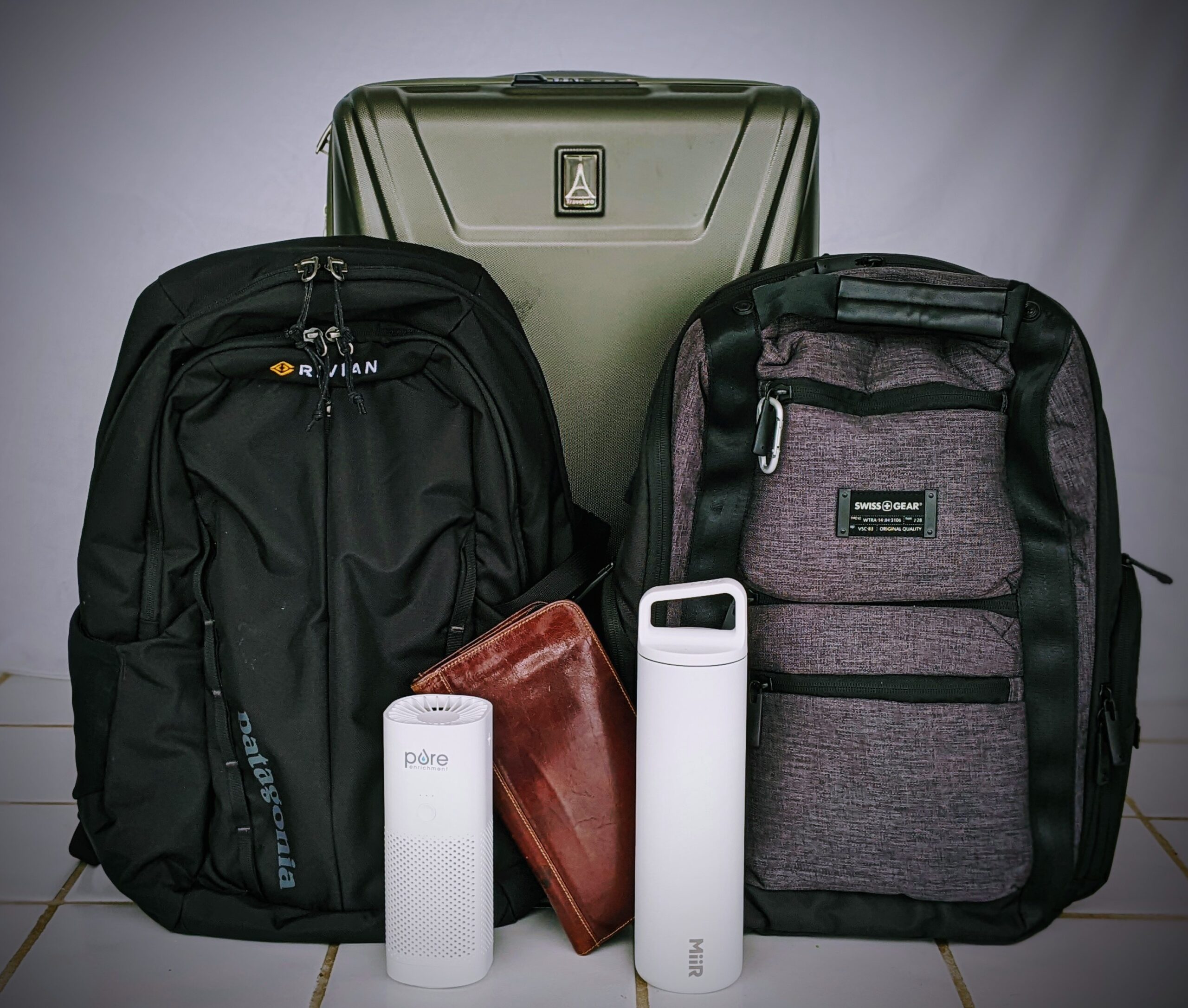
Here are some tried and true products that I am using to travel around Southeast Asia for five months.


Osprey Porter 46

Osprey Porter 46 travel pack (Osprey)

Osprey Porter 46 backpack. It has a neat appearance and the straps can be tucked away if you want to use the side handle. The whole front zips down so you don’t lose items in the bottom of the pack. Compression straps keep everything tidy.

Northface Recon daypack. This daypack has a laptop sleeve in the main compartment, a smaller compartment, a large mesh pocket in front and two water bottle sleeves on the side. A small pocket on top can hold an MP-3 player or

Royal Robbins Discovery skirt (black). A great travel skirt made of sturdy material with 3 pockets (zipper, snap and Velcro).

Reversible print skirt. Two skirts in one! Two different patterns provide different looks. A long skirt can be a little dressier, and can be a modest coverup when visiting temples or churches.

Tilley hat. This hardy hat packs flat, which is critical for travel, floats, has a secret pocket under the crown, lasts forever and comes in many styles, some offering ventilation to keep cool in the tropics.

Kindle. Holding 1,500 books it has made carry multiple books on long trips a breeze.

iPod. In addition to music, podcasts of your favorite shows can relieve the boredom of long bus rides in a foreign country. Many free language instruction podcasts are available on iTunes so you can learn the language.

Baggalini Wallet Bagg. A zippered pocket in front can hold passports, while 3 zippered pockets inside keeps money safe. It can accommodate a notebook and small camera. A sturdy strap is long enough to wear across the chest for extra security.

Katadyn MyBottle water purifier. Makes unpotable water safe to drink, filtering bacterial, protozoa, and viruses.

My packing list

If you’re really interested in the nitty-gritty, here is a list of what I’m taking. I have a few more things in my bag since it’s such a long journey, but really, once you pack light for one or two weeks, that should be able to take you around the world, unless you’re going to some extreme climates, like Everest. Ardent subscribers to the pack-light philosophy will find many extras on my list. I do want to look appropriate for a few different occasions, and I do have a few luxuries, but this is what works for me.  Despite my rationalizations I feel over packed by about a third.  I’ll be critically evaluating my load and will hopefully start shedding some extraneous items as we go. Brand names are included for your convenience (I do not receive any endorsement fees—these are just my tried and true favorites).

Travel backpack-Osprey Porter 46
5 blouses/T-shirts, mostly made of quick dry fabric
1 rashguard-beach shirt
1 pair of pants-quick dry (not jeans)
2 pairs of shorts-1 hiking, 1 nicer
1 pair of capri pants
4 pairs of shoes-light hiking boots, flip-flops, black water sandals, brown sandals
5 pairs of socks
5 pairs of underwear
2 purses-backpack purse, very small nicer purse for going out
PJs-tank top and sleep shorts
Sarong-can use as beach towel, cover-up, sheet, skirt
Toiletries-dry, includes travel prescriptions
Makeup bag-very small
Laundry supplies-powdered detergent, universal plug and travel clothesline
Katadyn Exstream water filter-the new product is called Katadyn MyBottle Purifier
Hat-Tilley Endurable T4-MO-packs flat, has a sun repellent brim
Down vest-compressed in a small ditty bag
Nylon jacket-folds into its own pocket, acts as a rain jacket, windbreaker, and with vest, provides warmth
Poncho-very lightweight, for rain

Daypack-Northface Recon
Laptop-lightweight Toshiba Portege
Kindle
Camera-SX 110
Travel documents
iPod Classic-120 GB capacity
Liquid toiletries- packed in TSA-required 3 oz bottles, so I can get at them easily when passing through security
Bag of liquid medications (contact lens solution)
Long sleeved white shirt-REI Sahara, used to ward of chill from air conditioning
Baggallini Wallet Bagg

To see how all this fits into my bag click here to view my videos on Packing Light, Part 1 and Part 2.


Resources

The Travel Independent website provides a comprehensive discussion about all aspects of backpacking and traveling light, and has useful information even if you’re not using a pack.

See Ten Tips for Packing Light for Overseas Travel at Examiner.com

Top photo: I Aksamit

Handling financial matters while traveling

Handling bills and other financial matters from another country used to be a giant headache back in the day when I was a child growing up in South East Asia. In this era, thanks to online banking and bill paying, it’s pretty easy to manage your finances when you’re traveling much the same way as you do from home.

Home-based bills

Security was tight at a bank in Costa Rica

Security was tight at a bank in Costa Rica

In our case, preparing for a months-long journey took a little planning, as we hadn’t yet automated everything. Several months ago we began tracking all of our bills to make sure they were all being captured on line. We made a simple spreadsheet and as each bill came in we systematically pursued on-line options.

We learned that, although we are able to pay every bill online, we were not able to get every bill routed through our on-line banking system from Bank of America. For some, like AAA, we’ll have to go on-line to their site to find our bill. A few provide email notification when a bill is due. For some critically important bills like the mortgage we decided to pay several months in advance so we wouldn’t have to worry about it.

We thought through all the bills we could think of that would come through while we will be away, especially the ones that are annual or less frequent. For example, my nursing license will expire while I’m gone and. While I can renew on-line, it has to be within a 90-day window of expiration, so I had to make a note to myself to remember to renew online during the trip. I also had to make sure I had all of my continuing education credits. I was a little short so I quickly found some free, on-line courses from Nurse.com and completed those before I left.

For our property taxes, which are due twice a year, we found that we could semi-automate the payment. We called ahead to confirm the amount and set up online payment.

Money matters while traveling

Monks in Vietnam

Monks in Vietnam bank with motorbike helmet

While on the road we’ll use a combination of credit cards, ATM and cash.We used to also use traveler’s checks but U.S. banks have mostly stopped issuing them. It’s handy to have US dollars, which are just about universally accepted. Some ATM machines in other countries can’t read U.S. ATM cards, but if you take it to a major bank they can usually perform the transaction manually. Some have limits on how much money you can withdraw in a day. In Italy it seemed like we were dipping into the ATM machine multiple times a day, and we quickly ran into our upper limit.  With a quick phone call to the bank we were able to increase our ATM limit, much to our chagrin.

Foreign transaction fees for currency conversion are associated with credit card use and ATM withdrawls so it’s best to check with the issuing bank so you’re not surprised. They generally charge 3% though there are some differences (see chart). We never take a cash advance from a credit card—fees can range up to a whopping 20% or more. We try to avoid using currency exchange kiosks at airports as the exchange rate will never be as good as an ATM or credit card, though occasionally we exchange a small amount of money for our initial transportation needs.

My credit card was being charged for some hotels we were arranging for the first leg of the trip, which the fraud division of the credit card company initially blocked. I let them know all the countries that might be involved and the date of departure so they would let the charges go through, but we had to call a different number to handle charges once we were on the road. 

One of our credit cards provided an on-line method for travel notification where we could enter the countries we would be visiting within a 30-day period. Unfortunately we have to repeat this process every 30 days. For a second credit card I had to call customer service, gave them all the locations for the entire trip and no subsequent calls are necessary. I called customer service for our debit card and was able to give them our travel plans for 90 days, at which time we’ll have to call again. We’ll all these tasks to our tracking spreadsheet so we can keep it all straight. It just goes to show that each card handles these matters in a different matter.

Going to the bank, which is a lost activity for most in the U.S., might seem like a hassle, and indeed, it is often time-consuming. However, it’s all part of experiencing the culture and customs of other countries. I rather enjoyed our lengthy wait in Ho Chih Minh City when we needed to cash in some traveler’s checks as it was refreshingly air-conditioned, provided endless, free, cups of chilled, filtered water and was a welcome respite from the mid-day heat. Watching the elegant Vietnamese women float across the marble floors in their graceful, flowing au dais (traditional Vietnamese clothing comprised of loose pants and long tunic) as they moved currency and paperwork from the vault to various desks made me feel acutely clumsy and encumbered in my Western clothing. Another day, in Nha Trang, I was amused to watch person after person dash into a small, crowded bank proudly sporting their motorbike helmets on their heads as they conducted their business. Two monks clad in flowing robes looked slightly less serious with their helmets on, later hopping on their motorbike, robes billowing in the wind.

Currency conversion chart

Steve created a handy wallet-sized currency conversion chart for all the countries we plan to visit. While it doesn’t take into consideration daily fluctuations in the exchange rate, it is helpful for estimating costs on the fly, especially for currencies with lots of zeros like the Vietnamese dong, currently at around 21,000 dong for US $1.00. Running across the top of chart he listed US $1, $5, $10, $15, $20. Along the left side of the chart he listed the various currencies we may be working with, including the Hong Kong dollar, dong, kip, reil, baht, ringgit, and Australian and New Zealand dollars. Then he filled in the various amounts per US values. He printed it in the size of a business card and “laminated” it by covering it with clear packing tape. We have a small calculator with us but find that this chart is usually all we need. You can find a similar, printable tool at Yahoo Finance.

Keeping money safe

I carry a Baggallini Small Wallet Bagg that is sturdy and not too bulky. There is a front pocket that is big enough to slip our passports in, and the main compartment has a zippered section for bills and two smaller zippered pockets for change and other small items. I can slip a small camera or my Flip video camera in there. There is a sturdy shoulder strap so I can wear it cross-wise across my body and I never let it out of my sight. It’s flat enough that I can keep it on my lap during meals under my napkin and not be tempted to place it on the floor or back of my seat where it would be more vulnerable.

We have a money belt but in the sweltering heat of the tropics it isn’t that comfortable. We split up our cash between us, and in the safe in the room, if available. My husband, Steve, puts money in different pockets. Basically, we try to make sure that money is dispersed across several locations.

So far, we’ve been lucky and have never had any problems with loss or theft. The worst that has happened has been of our own doing. Once, jet lagged, we had a layover in London en route to Dublin, Ireland, and had the bright idea to use the time efficiently to change some money. Imagine our surprise when we tried to use pounds in Dublin, only to realize, through the fog of sleep deprivation, that Ireland used Euros. We felt pretty silly.

Taking care of business is not the most exciting part of travel, but with a little research and preparation, can be handled with relative ease.


Baggallini Small Wallet Bagg

Baggallini Small Wallet Bagg